


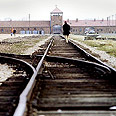
No Escape From Auschwitz
Holocaust survivors in an Israeli psychiatric hospital watched the TV broadcast of the ceremony in Poland
BAT YAM - Although M is 75 years old, he is still unable to free himself of the nightmare. At night he sees the Nazi soldiers slaughter his parents and siblings. Sixty years later he still hears the soldiers' marching. He experiences the horror anew.
M, along with 59 other Holocaust survivors, is hospitalized in the Abarbanel Mental Health Center in Bat Yam. Many of the survivors have been there for more than 40 years.
On Thursday afternoon they gathered in a small area next to the reception desk, where they sat on some old tattered sofas and watched the live television broadcast of a ceremony to mark 60 years since the liberation of Auschwitz.
"We see the barrracks, the fences, the guard towers, the final station of the railway tracks, which brought the condemned from the far corners of Europe to the burning ovens," President Moshe Katsav said at the event. "It seems as if we can still hear the dead crying out."
Katsav's words prompted some of the hospitalized survivors to weep. A few minutes after the start of the ceremony, some of them got out and tearfully walked to their closed rooms. It was just too difficult for them and brought back memories of the war - the same memories that shook their grip on sanity.
"It pained me greatly, and I wasn't able to watch the broadcast for long," said M, who was born in Belgium.
A few hours after the broadcast had ended, M was still shedding tears which he wiped away.
"This has a bad affect on me," he said. "The Nazis did such terrible things to us, and at night I continue to dream how they killed my family."
M spent the Holocaust in the Galizia ghetto and later in a Christian monostary.
"It's difficult to express in words how hard it was," he says with a piercing gaze.
Despite the pain, M is pleased the unprecedented ceremony was held.
"You see that our president is concerned about us, and it's good to see him there," M says. "Because of his presence there, there will never be another Holocaust. Although the terrorists try to murder us all the time, it's impossible to kill the Jewish people."
D, 91 from the Ukraine, fought the Nazis as part of the Red Army until 1942, and was later taken to Siberia. Since 1962 he has been in various psychiatric institutions in Israel and hospitalized in Abarbanel in recent years.
He hallucinates and thinks the people closest to him are betraying and devising conspiracies against him. He cannot escape the nagging thoughts. He takes medication intended to alleviate his suffering.
"To see on television the Israeli flag and our army at Auschwitz - that filled me with pride," he said. "It emphasizes the message 'Never again.' None of the Jews I knew in the Ukraine are still alive, my entire family perished, and this is very sad. To see people wearing blue and white in Auschwitz today made me happy."
Considering the horrific experiences of the Holocaust, mental health experts say it is incredible that so many survivors were able to return to some semblance of normalcy.
"The Holocaust was a place from which it was difficult to come out mentally intact and the human miracle is that hundreds of thousands of Holocaust survivors rehabilitated their lives and were able to create a family, to maintain a routine and to function," says Dr. Yoram Barak, director of the Abarbanel psychiatric ward.
"Today, in their old age, they pay for this a heavy price, and the break in their soul connects to death and suicide. It's terrible."
According to estimates, about 250,000 Holocaust survivors live in Israel today. Their average age is slightly more than 70, with the more elderly in their late 80s and early 90s.
The most recent survey to measure the survivor population in Israel was held just more than two years ago. It found some 270,000 survivors living in Israel.
Some 700 of the survivors in Israel are considered mentally ill. About 300 of them are hospitalized in three large hostels located next to psychiatric hospitals in the country. The others are in psychiatric hosptials.
All 60 survivors at Abarbanel chose to remain in the hospital. Here they will likely end their lives.
