


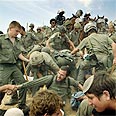
Settlers to be evacuated
צילום: איי פי
How disengagement will be carried out
Just over three months before the operation begins, Ynetnews sketches how the IDF will carry it out
TEL AVIV - An officer with the rank of major or higher will knock on the door and ask the family to come out – that's how the removal of settlers will begin on July 20.
For almost a year, the IDF has been planning the disengagement plan – one of the most complex processes in Israel's history.
Senior IDF sources told Ynetnews that the operation will occur during the day. Settlements will be removed one at a time, and inhabitants will only be notified that it's their turn right before evacuation, thus maintaining a momentum.
Only on Shabbat will there be no removals.
The officer will try to convince the family to leave on its own, but if it refuses, he will call the removal squad, 17 police officers backed by soldiers. A senior military source conceded that emptied homes might be re-occupied by opponents of evacuation, complicating the job of the soldiers and police officers.
Getting them out in one piece
The IDF is preparing for injuries. Ambulances will be stationed around the settlements and at the Kisufim Junction.
The property of the evacuees will be loaded on defense ministry trucks. The ministry is also operating 160 buses, monitored by the IDF's Technological and Logistics Branch, to move settlers to collection points outside the Gaza Strip.
In the next few weeks, reservists will replace enlisted soldiers so they can prepare for "Operation Brothers United."
The area will be secured by six concentric circles of police and soldiers to prevent anti-disengagement activists from entering the settlements. The fourth circle will guard against potential Palestinian terror attacks, while the first will deal directly with the settlers.
Female soldiers and officers will remove female settlers.
Meanwhile, the IDF Education Corps has been distributing information packets to troops which discuss such topics as a "people's army in a democratic country," "the history of settlement in Israel" and the responsibility to follow orders.
