


Painful acupuncture
Chinese arms affair hurts ties with U.S. and puts Defense official in hot seat
If you want a friend in Washington, President John F. Kennedy once advised, get yourself a dog.
Kennedy expressed what many politicians, before and after him, experienced: friendship between people, just like friendship between countries, is an elusive, fluid matter in this humid town.
One day, all doors open. The next day, they’re all shut down.
Most people resign themselves to this grim reality. However, Defense Ministry Director-General Amos Yaron is one Israeli who decided to fight back.
Israel has two types of friends in Washington: Those who offer unqualified support to Israel and are certain it is absolutely perfect, and those who love Israel a patronizing kind of love - they know better what’s good for it.
Harsh struggle
Douglas Feith, the number three figure in the U.S. Defense Department, belongs to the second group.
In the early 1990s, he served as the Israeli embassy’s legal consultant. He was angry at the concessions offered by then-Prime Minister Yitzhak Rabin in the Oslo Accords.
He promptly engaged in such a harsh struggle against Israel it forced the ambassador at the time, Itamar Rabinovich, to dismiss him.
Feith reached Washington following U.S. President George W. Bush’s first election win. Had the Protocols of the Elders of Zion been real, Feith and his boss Paul Wolfowitz would have been the fulfillment of their dream - Jews who have maintained a longstanding, emotional, political connection with the State of Israel and enthusiastic proponents of a military intervention in Iraq.
Amos Yaron met Feith in the Pentagon’s long corridors. They became close friends.
When I arrived at the Pentagon, Feith told Yaron, I found many unresolved cases of Israeli cunning when it came to military exports. You can close the cases, Yaron reassured him. I’ll ensure transparency in our work.
Yaron meant what he said. Feith believed him. But the Chinese affair was more powerful than both of them.
No real profits
By the outrage and the amount of words said and written about the matter it would seem Israel made billions of dollars from dealings with China’s military market.
The reality, however, is painfully meager: according to official Israeli sources, the scope of deals realized in the past four or five years does not exceed USD 35 million. In fact, Israel is in overdraft - the amount it made is dwarfed by the USD 300 million Amos Yaron was forced to pay the Chinese after Israel canceled, due to American pressure, the Falcon deal.
Until the disintegration of the Soviet Union, the Americans had an interest in boosting China. Later, their tastes changed.
Clinton’s Democratic administration entered into a series of clashes with the Chinese; Bush’s Republican administration found itself on the brink of war with them.
Yaron attempted to save something of the security establishment’s Chinese dreams, for naught.
The Pentagon was unwilling to allow Israel to sell China any kind of military equipment, not even shoelaces, without American approval.
Let’s agree to disagree, Yaron said.
Squaring off against his efforts at persuasion stood the amazing capabilities of the American spy agencies. Every email that passed between Beijing and Tel Aviv was intercepted and analyzed. Every contact was recorded. Every visit was considered.
The Pentagon attached great importance to these reports, and many of them made into the "early birds," the morning memos that shape how American leaders view the world.
The 'Harpy'
You are still working with the Chinese, Feith hurled out during a meeting with Yaron in March 2004.
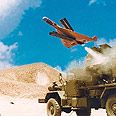
Yaron guessed that was being discussed was the "Harpy," an unmanned aerial vehicle that hones in on enemy radar and destroys itself with the target.
Israel sold the Chinese the UAV a while ago. The contract required Israel supply parts and replacements for 10 years. Indeed, a week after signing the deal, Israel Aircraft Industries received a mission and seven parts that the Chinese said needed repairing.
Don't do anything, said Yaron. Don't fix them. Don't return the parts to the Chinese.
He forgot to tell the Americans about the mission. Because the equipment was only worth a few hundred dollars, he did not consider it an important matter. He was wrong.
You tricked us, Feith accused. In a meeting with Israeli ambassador in Washington Danny Ayalon and the military attache Amos Yadlin, and in the presence of the deputy chief of the Joint Chiefs of Staff, he argued that Yaron lied to him.
The Pentagon set up an investigative committee. Relations with the defense establishment and with Yaron in particular were frozen. All of Yaron's requests to fly to Washington and to confront Feith were delayed. He was isolated here, too.
Sharansky comes home empty-handed
Advanced pilot education programs were canceled. Accusations against Israel reached the president.
The crisis put Prime Minister Ariel Sharon in a dilemma: He was not eager to talk to Bush about it. Sharon needed the good will of the president with regarding to a lot more important topics: disengagement, for example.
He could have talked to U.S. Defense Secretary Donald Rumsfeld about it, for example, but his advisers said that it was better to leave it for other echelons. His advisor Dov Weisglass had a heart-to-heart with Condoleezza Rice and Eliot Abrams: "Our hands are tied," They told him, "we won't interfere."
Feith, like all the neo-conservatives, respects Natan Sharansky. Sharansky volunteered to speak with him. For two hours, Feith unloaded on Yaron. Sharansky returned with empty hands.
Defense Minister Shaul Mofaz went to meet Rumsfeld armed with written explanations. Rabin or Moshe Arens would have banged on the table. Mofaz preferred to apologize.
The former IAF commander, Maj. Gen. (Ret.) Herzl Bodinger, was sent to the Americans. He sought a settlement.
"The Defense Ministry's director-general is someone who we trust," the Americans contended. "Essentially, he oversees the production of Israeli arms for us. The moment we lose faith in him, we can no longer work with him."
They argued the same thing regarding Yehiel Horev, who is in charge of the Defense Ministry's internal security.
We all scheme
Yaron, who after six years in the job wanted to leave, insisted on staying on. Sharon offered to make him a director-general of a large state company. He refused.
Yaron's real big problem was in trying to convince the Israelis. The unsaid assumption by everyone - politicians, the Israelis who dealt with the Americans, the reporters who covered the affair - is that Yaron is guilty of scheming.
We all scheme, and Defense Ministry people scheme more than everyone. If our best friends in America are telling us this, then they are right.
Or not.
Maybe the story here is not about the Israeli schemer, who sells weapons above and under the table, but rather, a haughty American who doesn't bother to check, who doesn't bother to prove, whose government behaves like a cowboy in the Wild West.
Arrogance is a distinguishing characteristic of the Pentagon in the Rumsfeld era. It did not end in Iraq.
The mission headed by Bodinger continued this week with its talks in Washington. Here, in Israel, there's a feeling of optimism: There's a chance that right after disengagement, either in September or October, Yaron will be invited to the Pentagon. After that, he will leave with his head held up high, and relations will return to normal.
Did this affair show that Israel in the Sharon era is completely dependent on an American patron?
Certainly not, says one of his advisers. On topics important to him, settlements for example, Sharon knows how to be stubborn. Those who pay much of the price of this relationship are the Americans, not us.
Nevertheless, the Americans can be bastards when they want. As James Baker, secretary of state for George Bush the Elder, put it to Rabin, "America is right even when it is not right."
Nahum Barnea is a columnist for Israel's leading newspaper Yedioth Ahronoth
