


Second-class citizen?
Renana Marmelstein writes about checkpoints and ID cards for Gaza settlers
I was attending a National Service seminar in Ofra but had a whole list of things to do: After my workshops; I planned to go home; give singer Ehud Banai a tour of Ganei Tal; go to his concert at Nitzanim, and relax a little bit after my matriculation exams.
None of it came to pass.
First thing in the morning, I received a phone call that Gush Katif was closed again, this time for good.
The Gush Katif residents at the seminar spent the rest of the day on the phone. We didn't go to our workshops, and all we could think about was getting home.
After several hours, we left Ofra. Along the way, I hitched a ride with someone without a Gush Katif ID card looking to get into Gaza. I didn't really believe she'd succeed, because on the way we passed at least three or four roadblocks.
At the roadblocks, I felt like a second-class citizen, like a number. I wanted soldiers and police officers to treat me like a human being, but they didn't. After all, orders are orders, and each of them is but a small cog in a largel operation.
But I didn't make trouble because I didn't want to make trouble for the folks with whom I'd hitched a ride. The girl without the "right" ID card managed to get into the Gush in the end.
Ehud Banai
I got home, got ready and went with two friends to take Ehud Banai on a tour of Gush Katif. It was really moving because, despite our totally conflicting opinions, he came because he cares about us. Because he knows what we are going through is not easy.
The visit showed that, despite it all, we are still one people.
The concert was due to start at 8 p.m. We hitched a ride early, having bought tickets in advance, but about a kilometer past the Kissufim Crossing traffic stopped for another roadblock.
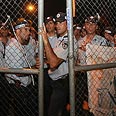
We got out to see what was happening, and we saw Gush residents blocking the road into Gaza in protest of being treated like "numbers" by having to show ID cards to pass the roadblock.
They weren't allowed to pass, and they started to demonstrate.
Immediately, we all started making calls, telling people to get to the roadblock. My friend Oriya and looked at each other, and thought together, "What should we do? Should we continue to the concert, or should we stay here and help fight for our homes?"
Without too much thought, we sold the tickets to some passersby, and stayed at Kissufim.
Face-to-face with security forces
I thought it would be a "normal" demonstration because we really hadn't done anything wrong and we were perfectly prepared to get in our cars and leave.
Then the police declared the demonstration illegal, and that's when things began to get out of control. People started pushing and punching, but it wasn't too bad. It's just not our way.
When a person has nothing to say, when there are just no words, he becomes violent. But we've got plenty to say; therefore, we don't hit.
Of course, there were people who tried to inflame the atmosphere, but they didn't succeed. When the police realized they couldn't get us out of the street, they called in the Special Border Police, on the principle that what can't be moved by force can be moved by even more force.
Eventually, we clapped for the Special Border Police Officers and yelled, "Way to go, heroes of Israel!"
They didn't know how to take it -- they were expecting a fight, you could see it in their eyes.
They lined up, and simply started moving to clear the area.
And we peacefully moved to the sides. They may have been stronger than us, but only in a physical sense. Because as soon as they stood against us and figured out that we wouldn't go back on the road, they were in shock.
Soldiers stood against girls only a year or two younger than they were. Then we started talking to them as they stood stone-faced with their arms crossed.
But, slowly. they "broke." We spoke straight to their hearts, all the while their commanders barking orders at them not to listen to us.
Any officer who started to break was immediately replaced.
After all, it's tough to face the truth: "What will you tell your kids when you get home from work tonight? That you beat up your brother? How will you tell your wife that you've gone to break up another family? Three years from now, your officer will go home. But this will remain on your conscience for the rest of your life."
"In another month, you'll come to kick us out of our homes," we said, "to put us on the street, to break apart families. How will you be able to look at yourself in the mirror afterwards?"
Several cops had tears in their eyes, and we could see it was truly hard for them. Essentially, Ariel Sharon sits at home dishing out orders, but these poor soldiers, my brothers, are the ones who have to carry out these terrible orders.
Let him come down here, let him be a man about it, let him drag a family out of its home. Let him see for himself how immoral and inhumane his plan is.
Eventually, the road was opened and many people got in without showing their ID cards. Others slept at Kissufim.
I needed to get home to study for my math matriculation exam. But when they asked for my ID card, I said didn't have it, because it got towed away with my car.
But they found an answer for my "excuses": There is a list with all the ID numbers of Gush Katif residents. At that moment, I felt like the lowest person in the world.
I believe the events of Sunday night will repeat themselves until they realize we will not be closed in and will not be treated like second-class citizens.
