



Meet the new finance minister
Olmert is a long term rival of Netanyahu, both personally and politically; will his appointment mark a change in economic policies, or will he continue along the path of market privatization pursued by Netanyahu?
Prime Minister Ariel Sharon could not have found a replacement for Benjamin Netanyahu that would aggravate the former finance minister more than the appointment Deputy Prime Minister and Trade and Industry Minister Ehud Olmert.
The political feuding which has characterized relations between the two has also spilt over into disagreements on economic policies, and Olmert has not hesitated to attack Netanyahu, often in press conferences.
Netanyahu, for his part, has never shied away from pointing out flaws in Olmert’s economic views.
Judging by Olmert’s past statements on economics however, it seems that the those in the business world need not fear the new finance minister.
Industrial support
Olmert has made no effort to hide his ties to the business sector. Relations between wealth and power are, according to Olmert, crucial for a good government understanding of market needs.
Olmert has fought against Netanyahu’s program, and has sought to preserve interest rates favorable to industrialists, in the context of the new law to encourage capital investments.
In his former role, Olmert worked to torpedo Bibi’s initiatives to make life harder for manufacturers while easing conditions for consumers, saying that it “was populist to place the consumer on an alter, while attacking the monopolies… its important not to forget that the industrialists provide work for thousands of people, and their interests must be safeguarded.”
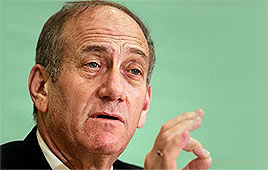
New Finance Minister Ehud Olmert (Photo: AP)
Olmert also attacked environmentalists, accusing them of delaying various projects. “The greens have turned into a religion, they are allowed to do anything,” he complained.
Olmert is also a passionate supporter of privatization. Despite the personal and political disputes between himself and Netanyahu, Olmert has made sure to praise Netanyahu at every opportunity over the “brave steps” the former finance minister has taken in advancing privatization.
In an interview with Ynet six months ago, Olmert even said that privatization is so important that companies should privatized at a low price. The high salaries of bank managers don’t bother Olmert, since these are private businesses, according to the new finance minister.
It is no surprise, therefore, that industrialists said they supported Olmert’s appointment, before it was even announced.
“I’ll fight for a social budget”
However, unlike Netanyahu, Olmert has often said that privatization and the advancement of the business sector should not harm vulnerable sectors.
Recently, he has said that he would “fight for a social budget” for 2006. He is a passionate supporter of subsidizing the employment of workers, is in favor of a negative tax policy, and is unafraid of breaking the budget to achieve those ends.
Olmert rarely misses an opportunity to express his concerns over the severity of the poverty crisis, and to attack Netanyahu for his anti-social policies.
He has supplied the media with more than a few harsh statements against the outgoing finance minister, saying for example that “the growing gap and polarization are creating two states.”
When Netanyahu once said that he “pushed the market out of the mud,” Olmert responded by saying that “Netanyahu’s car may be out of the mud, but the second car, that of most of the citizens, is swimming deep in the mud.”
Will Olmert be the one who gets them out? Will his policies as finance minister match his statements? Time will tell.
