


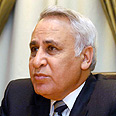
President, rabbi clash over pullout
Sparks fly in meeting meant to bridge gaps, as rabbi accuses president of ignoring tragedy, and Katsav takes exception to comaprisons between destruction of Temple and pullout
A confrontation took place between President Moshe Katsav and rabbi Haim Druckman, head of Bnei Akiva’s yeshivot (religious schools) on Sunday, after a meeting of public officials and spiritual leaders at the home of Katsav took an unexpected turn.
The president said during the meeting that the disengagement process was a difficult experience for all sectors of Israeli society, and that both secular and religious citizens had common worries about the pullout.
But rabbi Druckman answered the president’s comments by dismissing Katsav's words as empty slogans, and compared the pullout to the destruction of the holy Temple.
“In the public discourse, every side feels threatened,” said Katsav.
“Each of the two groups, religious and secular, sees itself as being in the right, and the other as dangerous. The trend for each camp is to demonize the other side and to fear it. There is a feeling of danger and a moral rebellion, and it is deep seated. These things are true of both sides, and it is time to recognize that the fear is real on both sides, and is not motivated by manipulation or provocation."
"Every side needs to understand that the other is equal to it. A national compromise is possible when it comes to state and religion,” said Katsav.
"There's a tragedy here"
Rabbi Druckman was not impressed by the president’s comments. “Mr. President, I had expected you to say something concrete, and not just slogans. I think there is a tragedy here, and I’m not trying to incite anything. I just came from Netzarim, where a synagogue service was reading the lamentations (prayers to mourn destruction of the Temple of Jerusalem), and people were crying. They identified with the destruction of the holy Temple. These people have lived there for tens of years. Some of communities that were established there came from Yamit, and no one thought they would be cleared once again.”
Katsav replied by saying, “I am also fasting today. I also read the lamentations, I read about the destruction the holy Temple, but in my opinion the comparison is false. This is not the destruction and this is not the end.”
“Of course it’s not the end,” said rabbi Druckman in response. “I’m not despairing, I’m just pointing out that there is a tragedy unfolding here, a private tragedy. The fact that segments of Israeli society don’t see this as a tragedy, and are celebrating the disengagement without thinking about the personal tragedy of those being cleared is the real problem.”
No Guilt
Author Eli Amir also took part in the meeting. Addressing rabbi Druckman, Amir said, “this may well be a private tragedy for those who built the communities there. But for me as a citizen, I have no feelings of guilt that the country decided to evacuate a territory in order to strengthen itself. As a secular citizen, I’ve done enough. I did not take the chance that the religious settlers took – to settle on occupied territory.”
“The government of Israel also made a mistake when it sent them to those territories and invested the national and personal fortune that it did in places that, at the end of the day, would have to be left,” added Amir.
“This country is in the process of being established. “Once we were worried about the ethnic division. Today the division is religious, it is based on land. There are people who are condoning the murder of the prime minister and that’s what I’m scared of.”
