


Shinui ditches Sharon
Prime minister meets with opposition leader Lapid, tells him he wants centrist Shinui party back in coalition; Lapid says Sharon's offer surprises him; Shinui turns down PM's offer, decides to vote against government
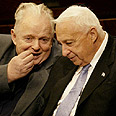
Sharon met Shinui coalition chairman Lapid in Tel Aviv Thursday morning and invited him to consider forming a coalition with Likud.
“I was surprised by Sharon’s offer to return to the government and I told him that we (Shinui) did not think about this option. Sharon then told me: ‘Why don’t you consider it? Then I understood that he wants his offer to be publicized,” he told Ynet.
The Shinui party convened in Tel Aviv Thursday, and unanimously decided to function as an opposition to the government, and to vote against it in matters such as the national budget and the appointment of new ministers.
Lapid relayed to party members the details of his meeting with the prime minister.
The Shinui leader insisted that he “did not come to the meeting to hold talks on the possibility of forming a coalition government. I announced that we will no longer support the government and will be a genuine opposition party."
“Sharon needs a majority for the budget and he has three oppositions: a minority in his own party, Shas and us (Shinui). He has to find a balance between all these parties. My feeling is he will go against the Likud rebels till the bitter end. In this case he needs support from outside,” Lapid added.
Sharon wants Shinui back in the coalition
Sharon took Lapid by surprise Thursday morning when he invited the centrist Shinui faction to return to the government.
“The period where I tolerated Likud faction members voting against me is over,” Sharon told Lapid in their meeting. The opposition leader replied: “If that’s the case, you’ll need Shinui more than ever. “ At that point, Sharon offered Shinui to join the government.
However, Lapid said that Shinui would only weigh the offer if its demands are met in several key areas, most notably the law exempting ultra-Orthodox from military service and a proposed legislation that would legalize civil marriages.
The prime minister said he was willing to look into the matter.
Meanwhile, Lapid lamented the stoppage of road work on the Shabbat at a central Israel interchange, a move that was prompted by ultra-Orthodox pressure and raised the ire of secular Israelis. Lapid told Sharon the work stoppage would lead to huge traffic jams during the week. Sharon replied that on this matter he must also take into account leading rabbis’ views.
However, Lapid also said Shinui no longer feels obligated to support the government now that the disengagement plan has been implemented, and added the party would now operate as genuine opposition, including when it comes to the state budget question.
Sources at Sharon’s office confirmed the possibility of a Shinui return to the government was raised during Thursday’s morning meeting, but said no breakthrough was achieved as a result of the ultra-Orthodox participation in the coalition. The sources also noted civil marriage legislation is impossible at this time due to political considerations.
Political maneuvering
Despite the dramatic proportions of the prime minister’s offer to Lapid, it is too early to start a celebratory party among the ranks of Shinui, because the proposal has slim chances to materialize.
Not long ago, last week, Sharon made the same proposal to Shas Chairman Eliyahu Yishai. It remains to be seen which of both parties is further away from the government in light of the current political zeitgeist. Under the current circumstances Shinui seems more distant from grabbing seats around the Cabinet table than the soldiers of Rabbi Ovadia Yosef, the party’s spiritual leader.
This reality has numerous reasons: a proposed bill to legalize civil marriage, the law exempting ultra-Orthodox citizens from military service, ultra-Orthodox government members and, most importantly, Likud and its willingness to swallow both Shinui and Labor in the same Likud-led government.
Political sources said that following Sharon’s win at the Central Committee, his main concern has been and remains to stabilize the political system and to ensure the 2006 budget is approved. In this respect, Sharon is eager to put pressure on the so-called “Likud rebels” by inviting undesired parties to join the coalition.
Shabbat row
Lapid, whose party until recently had been Likud’s coalition partner, lashed out at the prime minister over the weekend for currying favor with Haredi parties and bowing to their demands to halt Shabbat construction works on the Ganot Junction.
“The prime minister’s bribes for ultra-Orthodox parties in the form of endorsing the halt of construction works on the Ganot Junction Saturdays is a warning that he is taking a step back to the period of Haredi blackmail,” Lapid said Saturday soon after his return from a trip in Washington with the Knesset Defense and Foreign Affairs Committee.
“Shinui put an end to Haredi political blackmail when it was in government. Sharon’s people spoke of the possibility of a new centrist party yet it seems the prime minister has his face turned to the black side of Israel’s political spectrum,” the Shinui leader said, sarcastically referring to the black clothes worn by the ultra-Orthodox.
Over the weekend Prime Minister Sharon voiced his support for a move by ultra-Orthodox and religious parties to cease construction works on the Ganot Junction over Shabbat.
The request for the move was made to Sharon by MK Yakov Litzman, head of the Knesset Finance Committee, who was the first official to meet the prime minister in the framework of the negotiations currently being held between the Likud and religious parties.
