


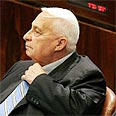
PM Sharon - Feeling the pressure?
צילום: איי אף פי
To be or not to be
Sharon still hasn’t decided whether he should stay in Likud
For the past 10 days the politicians have been preparing us for the moment of truth. A few of them are pulling their hair out; others spoke of sleepless nights and restless days. The fate of the government, or as they see it, the fate of the country, is at stake.
They are surprised to hear that this drama is of no interest to most Israelis. Last Monday, when Sharon promised to bring the new ministerial appointments to a Knesset vote, then recoiled after realizing that he was going to lose, the stock market was not affected; it did not fluctuate.
People on the street no longer hate politicians – they are sick and tired of them. Even when the politicians claim to bring good news – it is bad news.
Apparently it will happen this week. The moment of truth will come. Not because it must, but because that is the way things turned out. On Monday Sharon will bring the ministerial appointments of Ehud Olmert (to finance minister) and MKs Ronnie Bar-On and Zeev Boim to a Knesset vote. The prime minister’s problem centers on those Likud members who are regarded as “staunch rebels”: Benjamin Netanyahu, Uzi Landau, Michael Ratzon, Ayoob Kara, David Levy, Yuli Edelstein, Ehud Yatom and Naomi Blumenthal.
Six of the eight have publicly announced they would vote against the appointments, while two are still debating: Yatom and Blumenthal, who owes Bar-On a lot.
The math is against Sharon; one of his opponents in Likud already did the calculation for him: The coalition consists of 69 Knesset members, at most: 40 Likud, 19 Labor, two One Nation, five ultra-Orthodox, and three independent – Blumenthal, David Tal and Joseph Paritzky.
The opposition consists of 51 MKs. If you take the Likud “rebels” out of the equation, Sharon’s coalition is reduced to 61 MKs while the opposition includes 59.
However, the coalition contains seven others who are considered problematic: Labor MKs Amram Mitzna, Amir Peretz and Ilana Cohen, who threaten to vote against the prime minister’s initiative and four more (Yuval Steinitz, Moshe Kahlon, Gilad Erdan and Meir Porush) who are considering abstaining. Sharon is in the red.
Sharon’s salvage can appear in several different forms. Likud MKs Gideon Saar and Michael Eitan, who volunteered to mediate, are searching for a solution that would allow the Likud faction to get through the vote as one unit. Their initial talks with Benjamin Netanyahu and Uzi Landau resolved nothing. But they do have one sanction in the cards: If they fail, they may point an accusatory finger at one of the sides. As of now, no one wants to be perceived as being responsible for a split.
Sharon can turn to the Arab parties or to Shas and see to it that a number of opposition MKs will be absent from the vote. He may achieve this for a fair price. He can also give up on the appointment of two new ministers and make due with Olmert’s appointment to permanent finance minister – for this appointment he has at least 70 votes. He can also push it to the limit, lose, and continue as though nothing ever happened and appoint himself to the post of finance minister.
But he has to decide. His great difficulty at this moment is with himself. To be or not to be, asked Hamlet, and Sharon, who is in no way similar to a prince from Denmark, asks: To be in the Likud or not to be. Some say that Sharon loyalist Reuven Adler tells him he has reached the end of the road in Likud. Others are advising him to stay. Sharon himself has no answer.
When the country was in the midst of the disengagement process, Sharon had something to survive for. Now he has nothing left but to drag on to election time. The question is not only to be or not to be, but rather, what for.
What we have here is a duel between two men lacking strategy. Netanyahu was busy with one question this week: What is Sharon plotting (after he couldn’t come up with an answer he traveled to America, and will only return on the day of the vote, as long as the airplane doesn’t get stuck on the runway.) Sharon, meanwhile, was busy with one question: What is Netanyahu plotting.
Knesset Speaker Reuven Rivlin, in some sense the last Likudnik left, warned both of them. “It is possible that without you the Likud cannot be in power,” he told Sharon. “But even if you don’t admit this even to yourself, you know that you cannot be in power without the Likud.”
“You wanted Likud faction members to be complete subjected to you, like slaves. You want me to tell you I like everything you do. It doesn’t work that way. We don’t live under a presidential regime. Silvan (Shalom,) Tzachi (Hanegbi,) Danny (Naveh,) Limor (Livnat) and (Yisrael) Katz – all those people are unwilling to have their lives, their careers, depend on your wants. The moment you say you’ll bring in (former Shin Bet Director Avi) Dichter, you’ll get it from Silvan or Mofaz.
When Netanyahu quit the government he was convinced taking over the Likud was the easy part: The Central Committee will convene, decide to bring forward the primaries by a large majority, and Sharon will lose. Losing the Central Committee vote, Rivlin says, put Netanyahu in a state of shock. He was left without a strategy.
The Likud “rebels” want to humiliate Sharon, not toopple his government. Therefore, what emerges right now is a multi-phased chaos: Sharon presents the three ministerial appointments for a vote. Shas submits a no-confidence motion. The no-confidence vote requires a week’s delay, which Sharon cannot allow for, because Ehud Olmert’s temporary appointment will expire and he’ll be stuck without a finance minister for the rest of his term. Therefore he will have to call for a confidence vote, which takes place immediately. The rebels will call for voting by name. Once they reach 60 objectors they’ll stop. The appointments won’t go through. The government will survive.
This is too transparent, and therefore it likely won’t happen. Not that way. Even if Sharon is sick and tired of his government and party, he would find it difficult to use the rejection of Boim’s and Bar-On’s appointments as the grounds for a Likud split. He will have to move on to a more convincing excuse. The budget, for example .
Once this crisis is over, we may be able to say the following: Ronnie Bar-On has managed to shake governments in Israel twice. Twice he saw before him an appointment (last time as attorney general), but never made it there. The man who wasn’t appointed. His place in our political history may be assured not by what he did, but rather, but what he didn’t manage to do.
