


The poor will have to wait
Plan to narrow social gaps initiated by Sharon, Peres, Olmert nowhere close to being ready; with Sharon setting the elections for late February or early March, and Labor ministers on their way out of the coalition as early as Monday, a plan for fighting poverty remains as elusive as ever
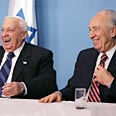
Three weeks ago Prime Minister Ariel Sharon, Vice Premier Shimon Peres and Vice Prime Minister Ehud Olmert met to discuss ways to fight the poverty in Israel.
Then, the social agenda of Labor Chairman Amir Peretz was still in the darkness, and the elections were safely set for November 2006, yet the attendees were well aware that if the government does not attend to narrowing the social gaps between the rich and poor, the chances for big success in the elections will be dim indeed.
At the conclusion of the meeting Sharon gave his two top ministers the green light to draft a plan for fighting poverty, a copy of which he wanted within two weeks.
Two weeks have past, Peretz won the Labor primaries in the meantime, and so far no plan has been laid on the cabinet meeting board. And, so it seems, no such plan will be presented in the near future.
A Ynet investigation reveals that the plan is still in the works, at least according to Prime Minister’s Office Director-General Ilan Cohen.
Yet even if Cohen’s assurances are proven true, the prime minister still lacks a majority to pass the 2006 budget in Knesset. In addition, the budget still needs to undergo dramatic alterations to please Sharon’s coalition partners, notably Labor ministers, who pushed for a NIS 4.5 billion (about USD 1 billion) for the deprived in Israel.
With Sharon setting the elections for late February or early March, and Labor ministers on their way out of the coalition as early as Monday, a plan for fighting poverty remains as elusive as ever.
The dubiousness of this situation leaves one to question whether the meeting between the three premiers was but a pre-election political maneuvering.
Signs pointing to this picture surfaced soon after the meeting with sources in the Prime Minister’s Office saying that the chunk demanded by Labor is unfeasible. A shy NIS 1 billion (about USD 222 million) was all that Sharon can draw from the Treasury’s coffers to alleviate the hardship of Israel’s poor.
Finance Minister Ehud Olmert made it clear that he has no intention to swell the budget even by a shekel. The intention was to funnel funds allocated to government ministries to finance the plan.
1.5 million live in poverty
For now at least the plan will certainly not see light in the next three months.
Minister of Housing and Construction, Isaac Herzog of Labor, has no disillusions. He knows that his efforts to press the government into fighting poverty have gone down the drain. In current zeitgeist the plan is in the limbo.
“On the eve of our exit from the government, I call on Sharon and Olmert to take responsibility for the gaps they created in Israeli society long before Labor joined them. I call on them not to abandon the plan for fighting poverty. The Labor Party and I intend to bring this plan back,” Herzog said.
The Prime Minister’s Office said in response to Herzog’s comments that there is no point in eulogizing the plan, despite the new political reality. “Although a plan should have been presented on Sunday, its draft has not been completed yet. We will implement the plan for fighting poverty as it is presented to us,” a source in the PMO told Ynet.
For now the truth remains that on the eve of the general elections 1.5 million Israelis, one in every three children, and one in every four elderly, live in poverty. In light of this grim picture, the government is unable to keep its promises to find solutions for the country’s poor.
For the meantime, Israel’s unprivileged will have to wait for after the elections, maybe then new assurances will be handed out.
