


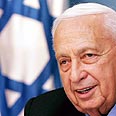
Only Sharon can
Why not just call it the Sharon Party? That's what it really is
The bride and groom in question were the children of two influential Likud Central Committee members, and of course Likud Knesset members showed up in full force. They wouldn't have had it any other way.
Except for the ones who've joined Sharon. Around Sharon, the question "Is anyone going to the wedding in Yehud" was met with uproarious laughter. Their fear of the central committee is gone.
Yesterday, as Sharon gave his press conference in the eastern part of the prime minister's office, his political advisors were busy throwing their Likud membership cards in the air over on the western side.
These images, borrowed from much more dramatic memories, such as the 1977 "revolution" that brought the Likud to power for the first time, when residents of development towns tossed their red union cards in the garbage, or Germans tearing down the Berlin Wall, or Iraqis pulling down statues of Sadaam Hussein in Baghdad, demonstrate the euphoria that gripped the Sharon camp Monday.
Their servitude was over. No longer would they be beholden to the whims of 3,000 wheelers-and-dealers whose power went to their heads.
From now on, they would be beholden only to the whims of one man: Ariel Sharon.
60 years, 5 1/2 parties
During a public career spanning 60 years, Sharon has been a member of no less than five-and-a-half political parties: During the 1950s we was a member of socialist Mapai, the ancestor of today's Labor Party; In 1973, upon his retirement from the IDF, he joined the Liberal Party; In 1977 he formed his own Shlomzion Party (Shlomzion is the name of one of the biblical queens, and the name means "complete land of Zion").
After the 1977 elections, he joined Herut and oversaw the merger of several right-wing parties into the Likud, and now he's announced his latest venture, currently nameless (the name ("national responsibility" is entirely temporary. Some of his advisors have suggested calling the party the "Sharon Party."
And why not? That's what it is. Others have suggested keeping things even more simple: The New Party. I think it should be called Rashi – the Hebrew acronym for Only Sharon can.)
Sharon was sharp, resolved, sure of himself and full of vitality during his press conference Monday. The adrenaline was flowing, the smell of battle made his nose twitch. The only sign of the sleepless nights he'd recently spent were the bags under his eyes.
He spoke about the Likud in harsh terms: "Life in that body became unbearable. You've got non-stop problems and obstacles to contend with. There is no way to lead," he said. He said he has come to the conclusion that Israel needs a completely new system of government.
Legitimate opposition
I'm not sure Sharon is right. The opposition he encountered in the Likud was mainly legitimate: He forced diplomatic moves on the party that were in direct contrast to their expectations.
He was unfettered by corruption in the central committee. To the contrary: a large portion of the corrupt ones were his supporters.
The Likud became corrupt, and so it's good that it's broken apart. Sharon has done a great service to Israeli politics, a service that falls not far behind the service he did for the State of Israel by pulling out of Gaza.
But political parties run by one man are far from a cure for the democracy-minded. Add to Sharon's list at least two more parties who currently appear to be colored with the brush of singular leaders: Shinui and Labor.
It's like Sharon himself says: "I ask lots of people for advice. I still ask for advice. At the end of the day, I make the decisions."
Keeping Sheetrit - barely
This style of leadership almost lost him the most dovish of all the Likud ministers, Meir Sheetrit. Sharon met with Sheetrit Sunday, many months after the latter advised him to break up the Likud.
This time, Sheetrit again pushed him to leave, but wanted to know at the same time what his place would be in the new entity. What are the plans? How are preparations going? He also advised him to give the Likud one last chance.
"Go to the party," said Sheetrit, "and spell out your policy objectives. If they accept them, stay. If not, let each faction go its separate way."
Sharon, according to Sheetrit, said, "Yeah, of course." That night, he heard on the radio that Sharon had decided to bolt. Sheetrit was hurt Sharon didn't tell him (Sharon's advisors say they left a message for Sheetrit). He was angry when he heard the new party list had been finalized and that Sharon had promised Shaul Mofaz a place.
At 4 p.m. Sharon asked Sheetrit for a reconciliation meeting. Sheetrit agreed, but only just.
Losing Mofaz
Monday, Sharon lost Mofaz (he promised to make Mofaz defense minister; Netanyahu quickly matched the offer), but got Yaakov Edri. His main gain was that he signed up 14 Knesset members. That's one-third of a faction.
He was lucky to have managed without bringing on Inbal Gavrieli. In an election campaign in which corruption promises to be the main issue, Gavrieli's mafioso uncle wouldn't be such a great asset.
Sharon has forged his path. So has Peretz. Soon, March 28 will officially become the date for elections. The next drama will be inside the Likud. Now, they are fighting about primaries; afterwards, they'll fight about choosing Knesset members from amongst Central Committee members. Reuven Rivlin speaks about war.
"At this point," said Rivlin, "There is no king of the Likud. Each person can do as he pleases."
Nahum Barnea is a columnist for Israel's leading newspaper Yedioth Ahronoth
