


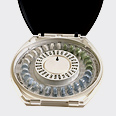
'There won’t be anymore unplanned children.' Birth control pills
צילום: סי די בנק
Foregoing the pill
Half of all Israeli 20-somethings rely on birth control pills to prevent pregnancy. But what happens when pills aren't the right answer?
Sarah, a 36-year-old graphic artist and mother of two daughters born 15 months apart says she only recently started thinking about family planning: "I met my husband when I was 28, and we fell head-over-heels in love. It was clear that we would get married; all we lacked was a child to complete the picture. I stopped taking the pill, got pregnant, and our older daughter was born.
"We didn't really worry about birth control afterwards. I went back on birth control pills for a short time, but they made me nauseous, and I stopped. I tried a diaphragm, but the process of inserting it was too complicated, and I also sometimes forgot where I'd put it. We gave condoms a try, but they were no great treat. Around a year and three months later our second daughter was born.
"Then we started to realize that without suitable birth control our family life and our sex life would suffer. We want another child or two but not at the moment. There won’t be anymore unplanned children.”
Sarah is not interested in going back on birth control pills. She still remembers the difficult nausea they caused her and is apprehensive also about gaining weight. In the last year she and her husband have used condoms or the coitus interruptus method to prevent pregnancy. "I know we are playing Russian roulette," she admits shyly.
Consider the number of partners
It turns out that many couples encounter similar problems. According to one American survey, a representative sample of 600 women of reproductive age (18-44) found that a large portion have serious questions about the correct birth control for them. Many claimed they are apprehensive about birth control pills out of concerns about cancer or weight gain. All of them said that their physicians are not sufficiently up-to-date on the subject of new birth control methods, especially for women over age 35.
Dr. Ronen Gold, senior gynecologist at the Liss maternity hospital, is dismissive of what he calls "myths tied to taking birth control pills:"
"The stories about cancer, becoming overweight, and hair on the face resulting from birth control pills have no scientific proof,” he claims.
Here in Israel, Dr. Gold says, half of all women between the ages of 20 to 30 rely on birth control pills to protect against unwanted pregnancy. Some also take them to regulate their menstrual periods," says Dr. Gold.
"In any case, we recommend to women over age 35 who also smoke not to take the pill, because of increased likelihood of blood clots and the risk of a stroke.
"Mainly, I tell every woman who comes to me she must decide for herself which birth control method (pills, diaphragm, vasectomy for male partner) is appropriate for her individual situation. Before that she must go through examinations in order to determine an inclination for excessive clotting, high cholesterol and high blood pressure.
“Likewise, one must check if the drugs she is taking have an influence on the preparation for preventing pregnancy. And single women must also take into account the number of partners she is likely to have, in order to ensure she is also protected against sexually transmitted diseases.”
