


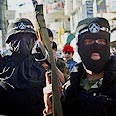
Al-Aqsa Brigades members
צילום: איי פי
Fatah primaries winner calls for peace
Al-Aqsa Martyrs Brigades Nablus commander Nasser Juma'a, wanted by IDF, tells Ynet he believes peace is 'necessary, possible says will advocate peaceful settlement when in parliament
During last Friday’s primary elections for Fatah leadership, the movement's young guard, and especially members of the al-Aqsa Martyrs Brigades, registered striking achievements.
One of these was Nasser Juma'a, commander of the al-Aqsa Brigades in Nablus, who won the majority of the votes in his town, with a total of 18,000.
Juma'a, one of the organization's prominent leaders in the Palestinian Authority, is also one of the most notorious suspects on the IDF's most-wanted list.
In an exclusive interview with Ynet, Juma'a calls on the Israelis to form true neighborliness with the Palestinians. "We must live in peace, there is no way around it," he said.
The newly-elected leader also pledged to address the issue of wanted suspects once he undertakes his new post, and said that it would be one of the first issues on the Palestinian parliament's agenda.
The 38-years-old Juma'a is married and has a son. He served seven years in an Israeli prison, and later spent another 15 months at a PA jail.
Do you intend to replace membership in the leadership of an organization that carries out terror attacks with membership in the leadership of a political movement?
This is not so unusual or unprecedented. The leaders of many countries originally came from the military field, including many Israelis who started out in military organizations or the army after the state was founded, and later became important political leaders.
We have decided to contend in order to strengthen the issues that we believe in – first and foremost, a profound reform in the Palestinian institutions. The military path was taken because we had no choice; this was forced on the Palestinians.
What is the significance of your election, as well as that of other al-Aqsa Brigades leaders?
We represent a different generation, a younger and more open generation, which in recent years has led the intifada, but that also called for a change and true reforms in the PA and the Fatah institutions. The fact that we were elected represents the desire for change within our public.
If you get elected to the Legislative Committee, which ministerial position would you like to receive?
You mean that I will become a minister (says jokingly). As the matter of fact, I didn't think about it, but I would like to be involved in anything in which I can make a difference. Naturally, because of my situation, I will prioritize the issue of the wanted suspects and their needs, in order to make sure this issue is resolved once and for all.
If we are in the middle of a diplomatic process, the persecution of wanted suspects must come to an end, as well as the threat to their lives. In general, I would be interested in handling the issues for which I was elected: The desire to fight corruption, to conduct large-scale reforms in the Authority and to strengthen the governmental institutions.
Of course we will address the issue of Palestinian prisoners in Israel, in addition to the more important issues like the struggle against the settlements and the need to find a solution to the problem of the refugees.
According to Juma'a, despite of his election he did not completely give up his life as a wanted suspect.
I continue to be extra cautious and alert. In the recent period, since the state of calm was announced, we feel a little safer and try to run a more ordinary life, in the hope that these risks will disappear.
Do you believe that the old Fatah leadership will allow you true freedom to act?
This is part of the generation-struggle in the movement. The fact that we were elected speaks for our determination not to let anyone take the role of guardian over us, our decisions and the policy we wish to pursue. We will let nobody take over our motivation and capabilities. We were elected based on a platform that says Fatah should undergo a deep reform."
How should Israel regard the fact that you and your friends were elected to parliament? Is there any chance for good neighborliness with you as part of the leadership?
Of course we can have good neighborliness; in fact, we must be able to live together, there is no escape from that. The Israelis have never tried to live side by side with us and regard us in any way other than as conquerors. We support peace and believe there is a need to achieve a true and just settlement. We have to live together, and in order for that to happen we must work out all the disputes between us.
Are these the same opinions you held when you were carrying a gun, or are you just saying so because of your new position?
No, this is what I believed all along, when I was part of the resistance and now. We say that life together is necessary and possible, but our election also symbolizes that resistance to the occupation is legitimate, and it does not prevent us from advocating the need to for peace.
