


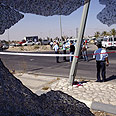
Be'er Sheva bombing aftermath (Archive photo)
צילום: אמיר כהן
Southerners still without fence
Residents upset over failure to complete security fence; State abandoned us, official says
Southern Israel residents say they feel abandoned by the government, which has thus far failed to construct the promised West Bank security fence in their region.
“The State of Israel is abandoning us as long as the security fence has not been completed,” read a letter sent to Prime Minister Ariel Sharon by Omer regional council head Pini Badash.
“We waited patiently till the end of the year yet to my deep regret a tour along the fence route today revealed that the fence has not been completed and as usual the Negev is at the bottom of your priorities," the letter said. "We demand work on the fence be completed.”
In August, following a suicide attack in Be'er Sheva, then Ministry of Defense Director General Amos Yaron said sections of the fence south of the Hebron Hills will be completed in 2005. A week is left before the year draws to its end and a lot of work remains to be done.
Despite the speedy work of contractors, the fence is far from complete. In fact, crossing over the infrastructure of the fence is easy by foot and by car.
'We are becoming target of every terrorist'
The threat of suicide bombers making their way from the Hebron area to communities across the other side of the porous fence is daunting. Be'er Sheva, Omer, Lehavim, Kibbutz Shomriya, Meitar, and Arad, are only a fraction of possible accessible targets.
While construction is uncompleted, the safety of southern residents lies in the hands of few Border Guard and IDF brigades manning the southern stretch of the fence. The completion of the fence will make their job much easier.
In the area of Shomriya, located 10 kilometers (about 6 miles) northeast of Be'er Sheva, pieces of the fence can be seen. A handful of contractors have been assigned different stretches and each has his own pace. Although funds have been made available for most of the planned route, petitions at the High Court against the government’s route halted construction indefinitely.
Meanwhiole, Jewish settlements like Tene Omarim and Eshkolot ended up on the Palestinian side of the fence and residents turned to Israel’s highest legal authority to alter the route to include them.
For the moment, residents await the court’s ruling to figure out their future. Yossi Mazuz, the secretary of Tene Omarim, told Ynet: “We are becoming the target of every terrorist. It is not necessary to go over a sophisticated fence. They can simply approach the settlement. We have been abandoned and neither the Ministry of Defense nor the High Court provide us with answers.”
The Government’s Coordination Office in the territories said petitions against certain sections of the fence have halted construction work awaiting a High Court decision. Under the current rate construction is expected to be completed by the end of 2006 at the earliest.
Solomon Cohen of Meitar said construction is one year behind of the initial timetable.
“We are helpless. There is nothing we can do but shout. I don’t mean to sound like a prophet but the government will remember its promises only after a horrible attack in the Negev. They are good only at speaking,” he said.
