


President Mubarak and King Abdullah
צילום: איי אף פי
Egypt, Jordan push for Mideast peace talks
Following Aqaba Summit, Egypt, Jordan express objection to unilateral Israeli moves
Jordan's King Abdullah and Egyptian President Hosni Mubarak have agreed to ask major powers to revive Middle East peace talks next month to pre-empt Israeli unilateral moves, their foreign ministers said on Saturday.
Both countries are worried about the prospects for Arab-Israeli peace after the election of a new Israeli government under Ehud Olmert and a new Palestinian government led by Hamas.
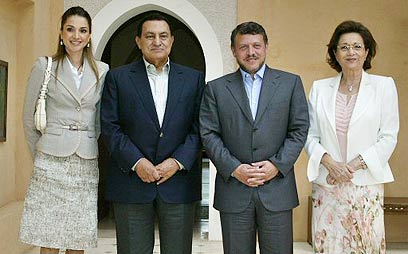
Summit in Aqaba (Photo: Reuters)
Olmert says he aims to set Israel's borders unilaterally if no basis can be found for negotiations - a prospect that seems remote since Hamas is sworn to Israel's destruction and has refused to sign up to existing interim peace deals.
After a summit in the Red Sea port of Aqaba, Egyptian Foreign Minister Ahmed Aboul Gheit and his Jordanian counterpart Abdelelah al-Khatib told reporters they would lobby a meeting of the Middle East "Quartet" In New York on May 9.
The Quartet comprises the United Nations, the European Union, the United States and Russia. Jordan and Egypt are to attend as regional partners from the Middle East.
"We believe the coming meeting of the Quartet to be very important and timely and coming after a long suspension of the peace process which faces a difficult period," Khatib said.
"There ought to be international efforts to push forward the peace process away from unilateral steps and a return to the negotiating table."
The Quartet backs a negotiated two-state solution, but its "Road map" For arriving there has been wrecked by many months of violence and increasing intransigence.
Egypt and Jordan, which both have peace treaties and diplomatic relations with Israel, want the Hamas-led government to accept an Arab peace initiative dating back to 2002. This offers Israel peace and normal ties in exchange for withdrawal from land occupied in the Middle East war of 1967.
Egyptian and Jordanian officials also discussed the financial plight of the Palestinian government, Aboul Gheit said without elaborating.
International donors, led by the United States, have halted direct aid because Hamas has not renounced violence, recognized Israel or agreed to abide by existing peace deals.
