


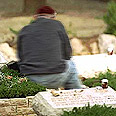
Too many to memorialize
צילום: לע"מ
No time for tears
Too many visits to bereaved families nearly broke me
6,000 Israeli soldiers and civilians died in the War of Independence.Newspapers featured a special section, called "Our Fallen," featuring the names, ages, and hometowns of the fallen. Six, maybe seven words, no more. There were too many people for more than that, and newspapers were small. It's all we have left of 6,000 people.
As the years went by, the number of deaths went down, thank God, and newspapers could allow themselves a bit more room to talk about each victim, many of whom were murdered by the "fedayeen," as Palestinian martyrs were known at that time.
If I remember correctly, the newspaper "This World" was the first one to dedicate more than a line or two to each death. At the end of the Sinai Campaign in 1956, the newspaper printed the details and full obituaries for 171 soldiers who fell in that operation.
Tough assignment
And so, as a young reporter for Yedioth Ahronoth years later, I found myself in an impossible situation: Together with the banner headlines about this-or-another IDF action, I found myself up before dawn (usually not having slept at all), to get a picture and "a few words" about our fallen soldiers.
In those days, the custom in the IDF was to wait till morning to deliver the terrible news to a newly-bereaved family. And so, at 6:00 or 7:00 in the morning, I would wait broken-hearted for a military attaché in front of a building in Tel Aviv, Jaffa, Ramat Gan or Petah Tikva, trying to guess where the family whose world was about to cave in lived.
I trembled in winter, but not from the cold; I sweated in summer, but not from the heat.
A few words
Their cries ripped apart the morning's silence. Then, sometimes even while the attaché was still sitting with the family, I forced myself to knock on the door. I couldn't really say "hello" or "good morning," so I just asked for a photo of their son, and for "a few words" for the newspaper.
My presence, their search for a recent photo and "a few words" almost always served to drive home the point that their son was really dead, that he wasn't coming back. It was a crushing moment – for them and for me.
But I had no time for tears. The newspaper needed the picture, needed "a few words."
By my reckoning, I must have visited 350-400 tragic homes. I remember each one, every family.
Break down
During the war of attrition, following the Six Day War, I broke down completely. Every day, day in and day out, I visited three, four, five families. It went on and on.
Eventually, I asked my friend Moshe Tamir, then the head of the IDF induction center, for help. Pleaded for help, more like it.
Without official permission, I asked Moshe to send me induction photos, known as "murder pix," taken on a soldier's first day in the IDF, so I wouldn't have to trouble the newly-bereaved families. He readily agreed, and saved me the tears.
It worked for a short while, until a certain Sapir family, from Kibbutz Gat, protested the matter to Chief of Staff Chaim Bar-Lev. Bar-Lev correctly put a stop to the practice, and I resumed my visits and confrontations with the cries and screams of bereaved parents.
Back to the future
Several years later, the clock was turned back 25 years: 3,000 IDF soldiers died in the Yom Kippur War, far too many to write full obituaries about each on. Just like the 6,000 from the War of Independence.
Today, I drive the streets of Tel Aviv, Bat Yam, Holon Ramat Gan, Petah Tikva and Netanya, and I remember each family. I don't notice the Bauhaus design, the geraniums out front or the well-lit entrance.
I see only a single bulb breaking the early-morning darkness and I hear the terrible cries of those horrible days. I ask myself which parents are still alive, how they deal with their pain, what they've done with their lives since then.
This column is dedicated to them, and to their fallen sons, in honor of Memorial Day.
