


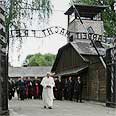
Pope Benedict in Auschwitz. Distorted translation
צילום: רויטרס
What did the pope really say?
Polish, Israeli newspapers report pope's visit to Auschwitz to fit their own ideas, not facts
Pope Benedict XVI's visit to Auschwitz-Birkenau continues to ignite Jewish and Catholic public opinion. His perverse sermon at the notorious concentration camp – in which he failed to ask forgiveness for the Holocaust, mention anti-Semitism, said the Jews were one of the many groups targeted for destruction at Auschwitz , absolved the German people of guilt for Nazism and mentioned just two prisoners: an anti-Semitic priest and a Jewish woman who converted to Christianity – was roundly criticized in the Western press.
The Pope furiously condemned editorials in the New York Times, Washington Post, Le Monde, Liberacion, Corriere della Sera, and even the National Catholic Reporter.
Italy's La Repubblica ran an especially furious piece by Marco Politi, who asked how Pope Ratzinger could have the gall "parenthesize Christian hatred for the Jews." Abraham Foxman, head of the Anti-Defamation League, expressed the feelings of many Jewish organizations: "We are unpleasantly surprised, angry and sad."
Who cares about facts?
Not that readers of some Israeli newspapers would know any of this. These papers set an editorial line that the pope's visit to Auschwitz was impressive, heartfelt, historic and symbolic and of course positive and good for reconciliation with the Jews.
They refuse to let the facts stand in the way of their opinions, and they hide inconvenient facts from their readers.
Something even more serious happened in Poland. There, opinion makers failed to understand what all the hullabaloo was all about – after all, the pope said explicitly: "I have come to ask forgiveness from the people who suffered here."
Well, not exactly. Turns out the pope's official Polish-language translator, one Father Ołdakowski, changed and added his own ideas while transcribing Benedict's words.
"I've come here to seek reconciliation – first of all with God, because only He can open and purify the hearts of men, but also from those who suffered here."
The only problem is the last seven words -"but also from those who suffered here." The pope never said them.
Skewed image
This distorted translation – the pope pointedly did NOT ask forgiveness – was heard by tens of millions of Poles who watched live broadcasts of the papal visit to Auschwitz-Birkenau, and was reported by the local media. Italian-speaking foreign journalists pointed out the translation error immediately, but it took three days for the mistake to be corrected to many Poles.
What inspired the translator to amend the speech? He won't say. But it would appear to be obvious: As a man of conscience, he felt this is what the pope could have, and should have, said at Auschwitz.
Benedict XVI was shocked by the severity of the criticism against his speech, and moved quickly to clearly denounce anti-Semitism.
But there is a difference between an after-the-fact condemnation and a clearly stated papal voice about anti-Jewish hatred and a plea for forgiveness from them on live TV, watched by millions of believers, from a German camp in which 1.2 million Jews were murdered, simply for the fact of being Jewish. Not because they were Hungarians, Czechs, Belgians or Poles.
Sever Plocker is the Chief Economics Editor and Member of the Editorial Board of "Yedioth Ahronoth"
