


Pride in the Arava
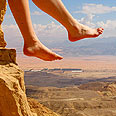
Instead of shiny attractions and gourmet restaurants, Arava region offers simplicity, tranquility and peacefulness – without any balloons or animal petting sites
Kibbutz Lotan: Desert green
Green. This is exactly how the residents of Kibbutz Lotan, a “green” kibbutz at the center of the Southern Arava, live their lives. The houses at the kibbutz are all built in “green construction” - local mud, desert rocks, used car tires and other artifacts that in other circumstances would find their place in the municipal dump. The kibbutz includes in its vision ecological principles, together with Judaism and Zionism. The kibbutz members eat three daily meals of natural and healthy food at the dinning hall, and dedicate a considerable portion of their lives to preserving the environment and spreading their world outlook.

At the center of the kibbutz operates the “Echo-Fun,” a center for creative ecology whose purpose is to instill principles related to recycling and environmental protection. This is done not in a theoretical fashion, but in reality, at the local level and in our own homes - how can we reduce, even by a small amount, the amount of debris we produce, and if we’ve already produced debris, how to use it again in order to maintain our planet cleaner and greener. To this end, the center for ecology operates tours which include explanations about recycling and environmental protection, a visit to a recycled playground, gaining experience in building in mud and a Lotan-style hospitality based on the natural and the organic. Also, there are desert treks, workshops and seminars centered on natural construction, preservation and more.
Additionally, there are two more attractions at Kibbutz Lotan. The first is a center for the art of touching water, which holds therapies and Watsu workshops, alongside other holistic activities, like meditation, Yoga Dance and Tai Chi. And the other one is a bird reserve which earned international recognition as one of the most important trails of birds' migration in the world.
Kibbutz Ketora: Magical fruits
Somewhat south of Kibbutz Moran and on the other side of the Arava Road, lies Kibbutz Ketora. At the entrance to the Kibbutz there are stretches of fields of long and narrow metal pipes. At first glance, an innocent tourist may think that the people at the kibbutz grow metal rolls. But the reasoning for this out-of-place sight is an innovative factory for growing see weed inside pipes. These seed weeds secrete a substance by the name of Astaxanthin, which has many uses in the world of medicine and cosmetics.
But this is not the only strange agricultura

l field in Ketora. One of the Kibbutz's members, the agronomist Dr. Elaine Salloway, has set up an experimental grove which includes over 250 species of fruit trees, cacti, chocolate fruit, Pitaya, 17 species of olive trees and other flora which do not grow in Israel. On week days, there are tours to the grove’s hiding spots, during which one can get the explanation behind the adaptation of plants to the desert, and one can also pick and eat some of the ripe fruits during this season.
Also, you can find in Ketora nice guest rooms at decent prices, bicycle renting options, desert art workshops (weaving baskets from palm trees) and other unique “branches” the members develop: Ted prepares cheesecakes; Marla paints the scenery, and so on.
Chan Shaharut: wall-to-wall accommodations
Chan Shaharut is a desert guest house, “Sinai-style,” that offers peace, tranquility and lots of quality time. It is located on the Haetekim Cliff at 540 meters above sea level, and from it the Edom Mountains and the Southern Arava stretch out, pure and deserted, almost with no human intervention.
The Chan is built from local mud stone, combined with wood and palm trees. In its inner section, there are places to sit on “wall-to-wall” Bedouin carpets. At night the Chan turns into a huge bedroom, but with some partitions also made of carpets one can have some privacy as well. There are also some private tents and air-conditioned rooms for the spoiled visitors. The meals are served at the center of the table on great trays, while sitting on the pillows. Even the food fits in with the general atmosphere – simple and basic.

Everything at Chan Shaharut is quiet and slow. There is no pressure, no attractions and no out-of-proportion spirituality. Those of you that are restless will also find something to do: From a simple trek through the goat trails to a 14-day camel tour to become acquainted with the desert.
Timna Park: Empowering the experience
A 20 minute drive from Eilat on the Arava road leads to Timna Park, a desert park with a biblical scenery characterized by unique and impressive stone formations, all nature-made. These are the result of rock erosion by the wind, water and dust. In ancient times, the Egyptians discovered huge copper deposits in the region, and dug 8,000 mining shafts (at a 40 meter depth) together with an endless network of tunnels.
The most famous rock formation in the park is “Solomon’s Columns,” which is how archeologist Nelson Glick named the immense rock columns that project from the hills. Glick, one of the first scientists that explored Israel in the 20th century, believed that at this spot King Solomon mined copper for Queen Sheba. Later, a shrine for the Egyptian godess “Hat’har” was uncovered near the columns, and the theory that attributes them to Israel’s king was pushed aside, but the name “Solomon Columns” still remains.
Additional rock formations that protrude above the surface are the “Mushroom” (whose source is in the decomposing of red sand rock), the small arch, the big arch, the copper lake and the valley of drawings and chariots, which includes a huge rock engraving of chariots led by bulls.
At the entrance to Timna Park there is a visitor’s center, which displays an audio-visual presentation which reviews the history of copper production in the region. Currently, three additional centers are due to open at the park (the size of the park is over 60 squared kilometers).

The park itself has about 25 marked trails, and at the beginning of each of them there is a blue box with information about the trails.
Timna Park is located at the Southern Arava, which turns the visit during noontime in the summer to a complex task. The park’s officials noticed the distress, and for a number of years hold on-site sunset tours. Starting first of July, Timna Park will also open for tours after dark.
To empower the experience, entire mountain ranges were outfitted with special lighting, which recount the ancient stories of the area: Ramses offers a gift to the Goddess Hat’har, a slave mines lead and copper, a donkey convoy transports copper, an Egyptian warrior chariot and more. On other ranges, wall paintings of animals in the region are shown: tiger, hyena, wolf and desert cat, and on the opposite mountains – antelope and ibex. The combination of the desert night and the impressive lighting delivers a unique tourist experience that leaves the visitors speechless.
