


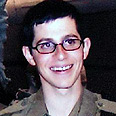
Kidnapped soldier Gilad Shalit
צילום רפרודוקציה: חגי אהרון
Why all the surprise?
There were repeated warnings about Palestinian attempt to kidnap soldiers. Why is everyone surprised it happened?
No one should be surprised about Sunday's attack at Kerem Shalom and the kidnapping of Gilad Shalit. The area was an attack waiting to happen. The night before the attack IDF commanders in the areas predicted the Palestinians would attempt an attack, and dispatched special forces to the area.
Border crossings were closed; cross-border commercial traffic was halted, even causing diplomatic damage – all because of increasing warnings over the past two weeks. Specifically, the warnings focused on anti-tank fire and a kidnapping.
Even the cell that kidnapped Gilad Shalit is well known to IDF forces. Several days ago, IDF soldiers entered Rafah to arrest two Palestinians with connections to the group. The move produced nothing.
Hamas ties
It is not out of the question that the kidnapping operation has close ties to Hamas' senior brass. There may be disagreement about what to do with Shalit, but whatever happens, the number of Palestinians in on the secret – from senior Hamas political and military officials down to the guys who actually dug the tunnel – was not small.
One barely need point out that the tunnel in question was not dug over night, and that it involved more than one digger. With this many people in on the secret, over an extended period of time, there should not have been any surprise. Not operational, not with regard to intelligence. Maybe there is something wrong with the system itself, not coincidental.
The kidnapping of a soldier is a strategic blow, the type of blow that changes the guidelines for military action and that stand in the way of diplomatic action. It is the type of action that can derail an entire country. Therefore, starting last night the IDF sent combat units to Gaza – just in case they need to reenter the Strip. No one wants this. But a strategic blow demands strategic answer. And if we need to re-occupy half of Gaza to free Gilad Shalit – so be it.
Entirely expected
In order to prevent ourselves slipping into depression and extreme solutions – preparations for a strategic blow must be made. It would be hard to criticize the IDF or security establishment if a soldier or Israeli civilian were to be kidnapped in downtown Tel Aviv. There, it is much harder to prepare and make plans. But right along there border? When the enemy has been warning openly and repeatedly to carry out just such an attack?
And after the surprise: How much time did it take the army to recover from the attack, to understand what had happened and to estimate the damage? When dealing with a kidnapping, anything not done in the first half hour is very hard to do afterwards.
And at Kerem Shalom, nothing was done for a long time. There were special forces on hand – they were prepared and shipped down south in anticipation of just such an attack – that could have sealed off the area and stopped the attackers' getaway. The tracks show that Shalit was taken alive and able to walk.
But the distance from Kerem Shalom to the large refugee camps near Gaza City is less than an hour's drive. The IDF lost the momentum. What could have been done with a small commando unit and a blaze of fire had the army responded immediately will now take an entire division, and a lot more fire power, if such a move is on the cards at all. This is how we react to warnings that hostile elements are planning to kidnap a soldier?
Failure to understand
So the combat forces failed to understand the intelligence reports, intelligence didn't really get the combat guys, etc. But what about all those methods for finding tunnels? The ones everybody knew were there, somewhere?
The State of Israel has been dealing with tunnels for ten years. We spend NIS 44 billion shekels on defense a year, we send up satellites, develop advanced missiles, but we can't find a few shekels to develop something to find the tunnels?
The army says it had no concrete warnings. What a pathetic joke. True, there was no detailed report documenting the exact path the attack would follow. But everything else was there in plain view.
Even the type of attack shouldn't be a surprise. The Palestinians have been digging tunnels near the Erez Crossing, have conducted complicated maneuvers and have already tried to kidnap soldiers. So what if we didn't know exactly which tunnel they'd be coming through?
Enemy information
Sunday's events at Kerem Shalom require an immediate investigation. We must not wait until the crisis has passed. The enemy has intelligence information, knows well the norms of our forces, the way the IDF works.
They carried out their attack at 5:30 Sunday morning, after a quite Shabbat. We can also assume they knew, amongst other things, that the back ramp of a Merkava tank is often left open, to spare soldiers the need to climb in and out of the top hatch. They also knew where the tank was, how many crew members it had, and they came to kidnap a soldier. And they succeeded.
In the test of results, the IDF failed. Now, it must quickly discern if there are other weak links in the chain along the border.
Gilad Shalit is alive. We know this from intelligence information, not just from the footprints leading away from the scene. Defense Minister Amir Peretz decided – against the advice of many senior IDF officials – to concentrate diplomatic and military forces in order to bring about Shalit's release. On then will we teach the Palestinian authority a lesson.
Nerves of steel
In order to apply pressure to get to the kidnapped soldier the army must return to the Philadelphi Route and cut off Gaza from Egypt. It must enter the refugee camps with a huge military force.
All options are open. The cabinet authorized the defense minister to use ground and air forces, and all Hamas officials – from Ismail Haniyeh on down – are in the crosshairs. If Mahmoud Abbas manages to secure Shalit's release – the entire equation could change.
Israel has found itself in the throes of a complicated security crisis since the Gaza beach incident that killed the Raliya family three weeks ago.
But to this point, the administration of this crisis by the country's politicians has been very problematic and foggy, to say the least. Now, add on to that crisis efforts to free a kidnapped soldier.
This situation requires politicians and diplomats with nerves of steel, patience and staying power. It is a game, against people with a lot of experience standing up to national-level crises.
We need leaders who know when to show restraint and when to release the safety latch.
