


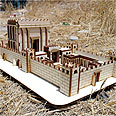
The temple
צילום: עמית שאבי
Crisis in Tammuz
How did the Jews in the desert reacted to Moses failure to arrive at the moment they expected to see him? Part two
Read part one: Tammuz and the forces of nature
The Jews in the desert responded to the crisis in three different ways. One group of people, Egyptians camp-followers and others who wanted to share the spiritual adventure that the Jews were on but also wanted everything to "make sense" to them, used the crutch that they had leaned on throughout their entire history. If what God does is "too big" to make sense to them, they will cut Him down to size, and force Him to fit into their pantheon of gods who represent various forces.
They no doubt thought that they could harness energy, make it work for them, and get on with life without seeking anything beyond themselves and their set of axioms. They pressured Aaron to form a representation of their spiritual autonomy, a calf that symbolized both newness and youth that had the potential one day to be an ox, the strongest of all the domesticated animals.
They envisioned themselves as empowered and talked themselves into believing that faith in a manmade symbol can actually evoke a spiritual force. In the era of rampant idol worship, this way of thinking "made sense."
Aaron did not realize how far this group had gone. He demanded that people give him their gold and jewelry, hoping that he would be able to buy time. Using occult forces, one of the idolotors took over the job of creating a symbol, and made the fabled golden calf. It seemed alive, real, and they believed that they had succeeded in making symbol that had vast spiritual power.
Group two: Natural born Jews
The second group was composed of born Jews and sincere converts. When they heard God proclaim, "Have no other gods before me," something deep inside of them was touched. They wanted truth more than comfort, and the very thought of any form of idol worship, or any deed that would block them from knowing and serving God, was completely abhorrent to them.
If they were left to their own devices, they would have probably managed to hold out until Moses' return, and later confront him with their fears that his prophecy had failed him since he didn't keep his word. When he would have explained his mistake, the air would clear, and their journey towards Israel would have continued as planned.
But they were not in isolation. The first group influenced them, as did their own conscience. Both sides seemed flat and untrue. They took refuge in cynicism towards Aaron and the Levites for remaining true to their "dead" leader rather than "being responsible" and "taking control" and "being realistic," and simultaneously mocked the passionate idolaters and satirized their devotions.
Group three: Believe in illusion
The third group was made up of people who realized that they were witnessing an entire nation betray everything that God had shown them: the plagues, the splitting of the sea, the Ten Commandments, the manna that came down from heaven. God had forced them to look beyond their limited horizons.
The people in this third group would neither reject what their own eyes had seen, nor would they take refuge in making skepticism a replacement for truth. But they, too, were caught up in illusion - an illusion far more insidious than the others. Their illusion was that there was no hope. The Jewish people were doomed. There was no point in trying to turn things around. The people they loved were choking by a noose that they had placed around their own necks: they were irredeemable.
They gave into one of the worst illusions that we have; the illusion that the force of evil generated by sin is greater than the force of good that is generated by tshuvah (return to God). They, too, attributed too much force to the golden calf. They should have seen it as precious metal twisted into an interesting form that holds attraction to people who don't know better.
When Moses came down from the mountain, he took in the entire situation as soon as he saw it. He acted swiftly, and allowed the Tablets to crash to the floor. The stone "body" of the Tablets shattered and the spiritual luminescence of their message flew back to their creator.
Was he right?
The Talmud tells us that there is no doubt about the matter. He was right. He did the equivalent of tearing up a marriage license before anyone could formally accuse a new bride of betraying her husband. If we could not rise above worshipping nature, submitting to the tyranny of human-conceived options and the possibility of destroying the authentic bond that we were promised - so be it. It is not as though we rejected the Tablets; we never had them to begin with. The tragedy was muted, which opened the way for forgiveness.
Echoes of the day
Four other traumatic events happened later in history that force us to think about who we are and who we want to be. To one degree or another, each event is an echo of the tragedy that took place on the 17th of Tammuz.
The Romans placed an idol in the sanctuary of the Holy Temple. No sacrilege could be more vulgar. The reason God allowed this to happen is that He wanted us to see where our chosen path would take us. By this time, we had lost our collective identity, and had buried our consciousness in endless in fighting.
Each group sincerely believed in their own cause. Each thought that they had a moral right to rule. Each took God out of the picture as they attacked each other with ever increasing savagery. The Romans had been conducting their public life like this for years. They believed in control, nature and power. We had the opportunity to see where this road leads. The end of the trail was the horror of and desecration of the sanctuary.
The walls around Jerusalem were breached. This is the date recorded in the Talmud as the beginning of the siege of Jerusalem. A breach in the wall was the beginning of the end. It could only happen when our faith was fragmented, and the divine protection that we had been given in the past was no longer something we could count on. What this means concretely is that if we wish to abandon our reliance on God and replace this with belief in ourselves or in nature, we will have to pay the price.
The daily offerings could no longer continue. In the time of both Temples a consequence of the battle for Jerusalem was that there was no possibility to continue the service as it had been conducted for hundreds of years. The symbolic meaning of the sacrifices is that it is up to us to elevate the world to God, not to create illusions that dwarf Him to make the "fit" more comfortable.
The Romans burned a Torah scroll. They believed in the rules made by man, not those made by God.
Does this mean that the month of Tammuz is "a bad month"? Far from it. It is a month of challenge and confrontation. Without challenge, there is no growth. Without confrontation, there is no way to see things as they are.
On the third of Tammuz something happened that broke all the rules of nature. Joshua was leading the Jews in battle in Givon against their enemies, the Emorites. As the day drew to a close, the battle had not yet reached an absolute conclusion. For the moment the Jews seemed to be winning, but if the battle would reach its inevitable end as darkness came, there would be no decisive victory, and the next morning they would face off against an enemy who would come at them with renewed vigor. Each moment was precious.
A miracle happened. The sun didn't set. The day stretched on for 12 more hours.
The rules were broken, the battle was won, and at least for the moment, no one worshipped the sun, but only its holy, infinite, unknowable Maker.
Reprinted with permission of Aish
