


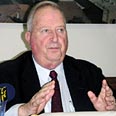
Former Finance Minister Avraham (Baiga) Shochat
צילום: אילן מרסיאנו
Desperately seeking Shochat
Former finance minister was excellent role model for today's pols
I keep desperately looking for Avraham (Baiga) Shochat. Not Shochat the man, but rather Shochat the phenomenon.
Were Shochat the finance minister today, he wouldn't be spending his weekends at home in north Tel Aviv (near the current finance minister's home). He would be moving around the north, from cities to towns to kibbutzim, the villages under Katushya and rocket attacks.
Baiga would roll up his sleeves and get to work, day and night, Shabbat and mid-week. He would offer help on the spot, solve vexing problems, and order underlings to ignore the rules, or to follow other rules.
He would offer a concerned hand to those still exposed to enemy fire, terror attacks, who feared for their futures, to those who lacked help and hope.
No 'Baigas' today
I'm looking for the Shochat of the Olmert government – someone to go out on a daily basis to the bomb shelters and towns of the north without pre-arranged press coverage. Shochat wouldn't feed the public huddled in bomb shelters some line about "in the framework of the budget" and "capital/production relations." He would just be with them, just to bring a little bit of the country's opulence.
When the Israeli government wanted to disengage from Gaza, it knew how to avoid the bureaucratic obstacles, including the Evacuation-Compensation Law. In order to ease the trauma of Gaza evacuees, those responsible for disengagement were given broad powers to solve problems on the spot. Only afterwards did the state comptroller come along, and that’s a good thing.
Who is left today in the north? Mostly the weaker sectors of the population. Those who couldn't allow themselves the luxury of a hotel in the Tel Aviv area, those who couldn’t move south, for health, social and economic reasons. Those who are worried about leaving their jobs and abandoning their private property. Many people simply got lost in the shuffle while the war was going on.
True, the local patriots are still there, Israelis who refuse to allow themselves to become refugees in their own country, war veterans who don't know the meaning of the word "fear."
Help wanted
But the clear majority of residents of the north need government help immediately. We need a "help commando" to distribute public financial and administrative help. We need somebody to be a "Baiga Shochat."
We need, but we aren't getting; therefore, we are forced to rely on civilian non-profit organizations.
Where is the government? Putting the entire burden on the home front and on the shoulders of inheritance tax inspectors. But their hands and their authority are of no use; we need a super-national administration to allocate meaningful funds, to sign the checks. That is why we pay taxes.
Financing disengagement
In 2004 the government allocated 8 billion shekels (USD 1.8 billion) to finance the Gaza disengagement. Every cent of it was given outside the regular budget framework. No ministry was asked to cut corners to finance the disengagement.
But today, with no deficit, the government lacks the courage to say that the civilian cost of this war will also come from outside the budget. I am trying to understand what the great disaster would be for our economy if the government interest rate was .5 percent instead of one percent.
Olmet, Livni, Peretz and Dichter are waging war. That keeps them busy enough.
But what is so very important that is keeping other government ministers from visiting Safed or Carmiel?
It is more than a question of concern or personal example. It is also a question of proper relations on the part of the government towards its citizens. How many ministers have sat in bomb shelters with little kids and the elderly, without the benefit of media photographers?
How many ministers spent this past Shabbat up north – in the north of the country, that is, not in north Tel Aviv? Could somebody please tell me who they are?
