


No instant results, where will it end?
As it seems at present, this war doesn't have an ending in circles outside of the general staff headquarters and the prime minister's office
Legend has it that the Davar newspaper (yes, there used to be such a newspaper) used to have a Jewish director called Gershon, or some other name. One day Gershon gave one of the typists an article for typesetting, and behold the typesetter reached the end of the page in the middle of the article.
"Gershon," wrote the typesetter to his boss, "the end is missing." The next day, half the article was published in the Davar newspaper, it ended with the three words that from that day on entered the pantheon of words: "Gershon, the end is missing."
"For the time being" we can sum up the offensive in Lebanon in similar terms. The emphasis is on "the time being." "Ehud (Olmert), the end is missing." As it seems at present, this war doesn't have an ending in circles outside of the general staff headquarters and the prime minister's office.
It seems as though both sides are waiting for someone from the outside (Condoleezza? Bush?) to bring a solution that may be accepted on the outside by loud protests but with much satisfaction from within. A forced solution from the American side (and once from the Russians as well), and in coordination with Washington, was a tried and tested ending for almost all of Israel's wars to date. So why not this time?
They can't disarm Hizbullah
One thing is almost certain: The Lebanese government is unable, even if it so wishes, to disarm the Hizbullah and disperse it. However regretful, this is the bitter reality. Subsequently, Hizbullah will continue to hold thousands of Katyusha rockets, and even if we collect them one by one like abandoned eggs, their Syrian friends will re-supply the stocks.
The war at present, therefore, is not being waged against the Katyusha rockets but in distancing the Hizbullah militants from the range that enables them to easily spit fire towards civilian targets in Israel. A well known secret, known to the Hizbullah as well, is that the patience of more than a thousand Israeli civilians sitting out the war in the bomb shelters is running out, and the IDF will do anything in its power to relieve them of this burden.
Distancing the range of the Katyusha rockets and making it difficult for the Hizbullah to fire rockets at northern settlements (and almost central Israel) calls for a massive ground offensive. The most sophisticated aircraft and missiles in Israeli hands cannot pile the Hizbullah onto trucks in order to flee, to go north.
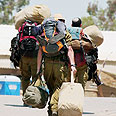
Subsequently, the three military divisions called to the flag this week, including the entire IDF, will not return home in the near future. They will operate on the ground to enable the citizens of Haifa and Akko, Safed and Nahariya to get a breather.
Victory in points, not a knockout
One can say therefore that, there is almost no escape from a ground offensive whose heavy price will incidentally be paid by the inhabitants and civilians of the south of Lebanon. The question being raised at present is how far from the Israeli border will the IDF forces go to distance the Hizbullah rockets.
There's not much point in sufficing with a short distance from the border, because this will not stop Hizbullah from firing the rockets. Moreover, they will be imbued with motivation to show us what they can do.
Therefore, the obvious conclusion is that a ground offensive may or will, according to the standpoint of the observer, continue to take great strides, including conquering cities on its way to Beirut.
This of course is only one of the scenarios, and there may others that are very different. Either way, any scenario at this point must assure victory in points for our side, because apparently it cannot be achieved by a knockout. There are no instant results.
If some kind of solution dosen't fall out of the sky in the coming days, then we ought to return to the beginning of the story: ladies and gentlemen, the end is missing.
