


Lebanese army's moment of truth
(VIDEO) Three brigades expected to deploy south of Litani River, start moving southward Thursday morning. IDF prepares to hand over territory to neighboring army; officials estimate Israel will evacuate southern Lebanon within 10 days, despite worrying declarations made by Hizbullah

The Lebanese army will embark on the first stages of deploying its forces south of the Litani River, in the area where the Israel Defense Forces recently operated against Hizbullah, after the move was approved Wednesday by Fouad Siniora's government. Israel is waiting to see how things will be implemented in the field.
Lebanese troops, tanks and armored vehicles began deploying Thursday to southern Lebanon in line with the UN ceasefire plan.
The vanguard of the force crossed the Litani River at its mouth on the Mediterranean coastline, 30 kilometers (18 miles) north of the Israeli border, at about 6:40 a.m. Ten armored carriers mounted on flatbed trucks drove across a newly installed metal bridge over the river, escorted by several other military vehicles. The bridge was built by the army to replace a structure that was bombed by Israeli warplanes during the 34-day offensive.
Flatbed trucks carrying a total of 20 tanks arrived in the town of Marjayoun, a key town near the Israeli border that was briefly occupied by Israeli forces during their incursion into Lebanon last week. There were also a dozen trucks loaded with troops and hoisting the Lebanese flags. The convoy drove through the destroyed part of the inland town, 10 kilometers (6 miles) north of Israel's Upper Galilee panhandle, kicking up dust.
Brig. Gen. Charles Sheikhani, speaking outside the Marjayoun military barracks where Israeli troops were based during their brief occupation, said the entire 10th Brigade of 2,500 men he commands would be in charge of a region from Khardali to Chebaa in the west and east to the border town of Kfar Kila to the south.
"Since 1968 the army has not come here. This is our first time since then. We're happy to deploy our army to the south of Lebanon," Sheikhani said.
Dramatic move
According to the Lebanese government's decision, 15,000 soldiers will be sent to the south, including reserve forces, and will later be joined by international forces.
This is considered a dramatic move, in light of the fact that this is the first time since the 1970's in which the Lebanese army will deploy in significant forces – about three brigades – in the south of the country.
In the past 30 years, since the Lebanese Civil War, the Syrians were the influential elements in southern Lebanon and the local army's presence was insignificant. Official sources in Lebanon stressed that the soldiers who will now deploy in the area will enforce their authority and will not allow the presence of any armed group.
In the meantime, the IDF is also preparing for the Lebanese army's arrival and is getting ready to continue removing its reserve forces and soldiers in compulsory service from the fighting zone.
The process of handing over the control of the area, which will be carried out in stages, began Wednesday night, in accordance with a joint agreement between the IDF, the Lebanese army and UNIFIL. IDF officials stressed that the process would be continued only if the UNIFIL force is boosted and the Lebanese army gains real control over the area.
"The Lebanese army committed to preventing Hibzullah's activity from all the areas it controls and to later operate to remove Hizbullah from the area. As long as IDF forces are in the area they will be allowed to defend themselves with all means, and there will be no situation in which their lives will be in risk or under threat," an IDF official said. "The deployment of the Lebanese army in the south is one of Israel's diplomatic goals and was one of the goals of Operation Change of Direction."
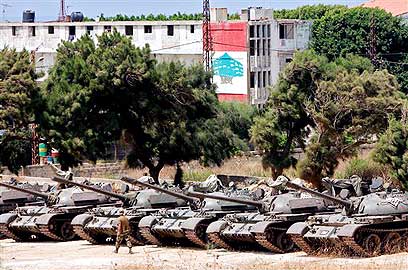
Headed south: Lebanese army tanks (Photo: AP)
Meanwhile, UN Secretary-General Kofi Annan met Wednesday with Foreign Minister Tzipi Livni and promised her that a first multinational force of 3,500 soldiers will be sent to the region within a week to 10 days. The force will be mainly comprised by French troops, along with soldiers from Italy, Spain and other countries.
French Defense Minister Michele Alliot-Marie said that her country would be ready to lead the multinational force's soldiers at least until February, while Austria announced that it would not send soldiers to Lebanon. Representatives of the countries planning to send troops as part of the force is expected to convene in New York on Thursday.
IDF estimates withdrawal within 10 days
While Israel hopes the Lebanese government will send troops to the south to prevent Hizbullah activity in the area, the Shiite group announced on Wednesday that it won't disarm.
Hassan Fadlallah, a Shiite legislator, said the group cannot be asked to withdraw its fighters north of the Litani River because most of its supporters and fighters live in the south. Fadlallah said Hizbullah's arms are not for discussion, neither in Lebanon nor abroad.
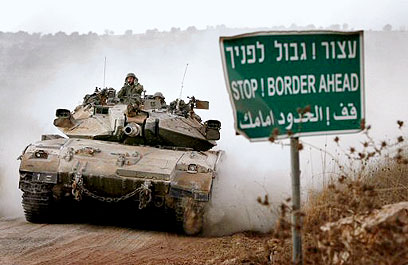
Headed home: IDF tank in southern Lebanon (Photo: Reuters)
Hizbullah's defiance did not affect the IDF's plan to complete its withdrawal from southern Lebanon within seven to 10 days. A senior source in the Northern Command said, however, that the IDF was preparing for a scenario in which troops have to remain for a longer time in southern Lebanon.
IDF reserve troops continue to return to Israel, while regular forces are deploying instead. The IDF would like to reach a situation in which no reserve soldiers will stay in the area.
Ronny Sofer, Yitzhak Benhorin and the Associated Press contributed to the report
