


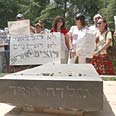
Why Golda?
Protesters got it wrong by using image of late prime minister
Follow Golda's example, protesters told Ehud Olmert: Follow her example and step down. But Meir, the prime minister who oversaw the failures of the Yom Kippur War, is no example to emulate. When that war ended and the reservists' protest movement gathered steam, Golda tried to hide behind the claim that what did she, a woman, knows about military issues? She relid on the generals.
The street didn't buy it and she was forced to set up a commission of inquiry. She and advisor Yisrael Glili took care to push the commission away from the politicians.
Gimmick
The current reservists' pilgrimage to her grave is a gimmick, nothing more. As opposed to their predecessors, they know that without gimmicks they have no chance to get into the public consciousness.
The Agranat Commission completed its work in March, 1974. It recommended dismissing then-Chief of Staff David Elazar, and Golda quickly told Elazar to resign.
Elazar's resignation failed to placate the protesters, and in April Defense Minister Moshe Dayan was forced out. Golda vacillated another week, during which she heard pleas from Labor Party members and her daughter to stay, stay, stay. But at the end of the week she submitted her resignation. She was 76 years old at the time; her age and advancing cancer did what demonstrations could not do.
Stellar irony
The irony of it all is that during the war, Golda gave the country outstanding military leadership. In contrast to Generals Dayan and Ze'evi, who panicked and threw around ridiculous ideas, Golda remained cool and retained confidence in our forces.
Her success couldn't change the fact that she was responsible for years of neglect, arrogance and lack of transparency. To a very large degree, she was the failure.
Similarities, differences
There are more than a few similarities between the 1973-74 protesters and those of 2006: The anger of combat soldiers over the deaths of their friends, a loss of faith in the chain of command, from Olmert, Peretz and Halutz on down, their concentration on simple demands, demands that can be sprawled on a t-shirt.
But there are also differences. Then, thousands of reservists descended on Jerusalem; today, there are barely hundreds. Maybe it's because there is less reserve duty today. Perhaps it's because this war left 158 dead soldiers behind; that war left 2,600.
Perhaps it's because it's August, when the sun is oppressively hot; then, protesters were out in March, when the sun is gentle. And maybe it's because Israelis are a lot more desperate than they were then.
Then, people believed that if only the failures were investigated, redemption would come. Today, they look at the potential redeemers ? Netanyahu, Lieberman, the Orange brigades? And they prefer to stay home. The true danger to democracy is not protest. It is despair.
Deserving of praise
The protesting reservists are Israelis who care, praiseworthy Israelis. I got to know some of them in Lebanon, when their anger was still occupied, and I came to respect and to like them. They want to punish the guilty, but no less than that they want to correct problems: With the army, they way the home front is dealt with, decision making in the political echelon.
In contrast to them, I must deal with the question of what happens the day after they get what they want and Olmert, Peretz and Halutz resign. Their protest must be judged on more than their good intentions, but rather according to the benefits or damage they stand to cause. They are walking a very narrow bridge.
I've got no doubt that if Golda could see the hundreds of protesters that have come to visit, she would be thrilled. "They are very nice," she would say, and add in that classic suspicious manner of hers: "They were looking for Rabin's grave and got lost on the way."
