


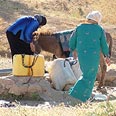
Poverty in Bedouin villages: Where has State disappeared to?
Some 52 percent of Arabs in Israel live beneath poverty line, many of them Bedouins living in south. Government gives them nearly no help, and those who do are non-profits, volunteer organizations. Yossi Kramer, welfare services social worker in Bedouin villages: 'Vacuum left by state is filled by religious parties and empathy with Palestinians'
In Bedouin villages in the south, the numbers turn into harsh reality, and behind every statistic is a family, most likely a family with many children. However, while these same families are being asked to get out of the cycle of poverty, the government does practically nothing to help them. So, they are forced to seek help from non-profits and volunteer organizations, and many of them are compelled toward religion.
One of the ways out of the cycle of poverty is entry into the workforce and higher education. In the Bedouin villages, most of the women haven't finished high school, and a large portion of them don't work.
The Negev Development Authority decided to open two original courses targeted at Bedouin women only – a photography course with an emphasis on special occasions and a recording course. As much as it sounds unreal, interest in the two courses was high.
Weaving carpets for established Jews
The Center for Jewish-Arab Economic Development is also trying to solve the problem. The head of the Women's Empowerment Unit at the center, Kiram Baloum, told Ynet, "We are trying to integrate women into small businesses, and, in effect, to open doors for them. We hold a lot of activities and there are many success stories, but this is all from foreign money that doesn't come from the government."
Those same small businesses take advantage of the positive attributes of Bedouin women for economic, and even profitable, business. One of the projects that has gained momentum is in the village of Lakiya in the Negev, where women work weaving carpets, which have become a real trend. In established houses and towns in Israel, one can find the fruit of these women's work.
'Islam forbids limiting reproduction'
One of the problems making it difficult to leave the cycle of poverty is the large number of children in Bedouin families. Despite the economic conditions, many people continue to bring children into the world. Deputy-director of welfare services in Rahat, Sayyid al-Aubra: "It is forbidden for Muslims to talk about limiting reproduction. Even though Islam forbids it, my opinion on the subject is different. In the past, the stronger your family was the stronger it was considered. I want quality for children, and not quantity."
According to al-Aubra, "In order to limit reproduction, you must do the work in the neighborhoods, with the people, and not in government offices or discussions."
The director of the welfare department in Segev Shalom, Khir Elbaz, blames to government for not taking charge and starting a campaign for limiting reproduction.
He says, "Bedouin society needs to be a serious partner in these processes, but it needs institutional help. It isn't enough to rely on internal powers. Government bodies and extra-governmental bodies, such as non-profits, need to hold hands and work together."
The government, for its part, has declared a "southern" plan, a strategic plan for developing the Negev, one of whose departments focuses on the Bedouin population. The government didn't forget to mention the plan at every possible opportunity, but has as of yet not put it into action.
