


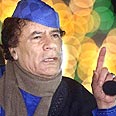
From La Belle to Lockerbie
International appeasement has kept Gaddafi's spirit alive, now he calls for political murder
There is an unspoken dream among many people: A cruel dictator is looking into a mirror, recognizes his failures and decides to make a change. Some may call this dream naive and wishful thinking. Others may find parallels in biblical prophecy or remember Friedrich Schiller´s ballad Die Bürgschaft (The Surety).
Anyway, isn´t regime-change from inside the best way for the axis of evil to loose its wheels? It was in May 1995, when this dream was actually dreamt by a young German student that was me. Not without good reasons: One of the world´s most prominent dictators seemed to make a change. Libya's Muammar al-Gaddafi.
A news magazine has just recited his recent book, with a long title and short stories inside. Suddenly, the article looked interesting. One could read criticism between the lines, criticism of politics, society and religion. Was this be the beginning of a new era?
Can he change?
Sceptics would have denied this. But six years after the iron curtain fell nothing seemed impossible, especially at a time when Israelis and Palestinians won the Nobel Peace Prize.
No doubt: Gaddafi was responsible for many terrorist attacks. He formed Libya to a military dictatorship that left nearly no rights for the individual. Personally, he called for the liquidation of his opponents, at home and abroad. Not to mention his grotesque political dreams and “visions”. Reagan once called Gaddafi “the mad dog of the Middle East.” But what if he has changed? It was time to find it out.
To get in touch with Libya has no comparison. In the early 1990s the country was virtually isolated. UN sanctions prohibited international flights after the regime gave shelter to two suspected nationals wanted for trial in the Lockerbie case.
Lockerbie? Since 1988 the name of the Scottish village has become a synonym for one of the worst attacks on civil aviation, when 290 passengers aboard Pan Am Flight 103 died. Indeed, the sanctions have worked: In April 1997, the Libyan regime organized an international “solidarity festival” to get them lifted.
Festival or a nightmare?
More accidentally, I was invited, too, and found myself among diplomats, ministers and political representatives from around the globe.
The participants of what could best be called a propaganda show had to enter the country by bus. International flights ended in Djerba. Those who expected any political discussions were disappointed. The rhetoric was flat and the schedule highly unorganised. For some it was a nightmare in Tripoli, but a few naive supporters found everything great.
The real revolution began when everyone prepared for departure. Suddenly, we were brought to the Airport, where national flights were not forbidden, and flown to Surt, where Gaddafi was waiting. Following a long and monotonous speech, the listeners had a chance to surround and embrace the “brother leader”. I decided to leave out this opportunity.
The following years it became obvious that the Libyan regime had little interest in political reforms. Instead, reports from Amnesty international repeatedly mentioned a "climate of fear" and spoke of "no chance for dissenting voices."
This seemed to change in summer 2000. During the hostage crisis in the Philippines one of Gaddafi´s sons led talks with the kidnappers and became publicly known as a new figure. Saif al Islam, educated in Europe, soon brought up hopes for political reforms. Some analysts even speculated, that he might one day succeed his father.
With this new climate to unfold, I decided to revive the buried dream: With a book project I hoped to accompany a process of political reform. This time, it took only a few months for a personal invitation.
Democracy was the question
Not everyone was happy about the project. Some old revolutionaries tried to block it, since they were uncertain about my intentions. Instead of praising their ideology, I argued for diplomatic relations with Israel. Democracy was the question, and Gaddafi was the one who should give me the answer.
A few months later, the interview was set to take place: The third trip to Tripoli. The Libyans however were unable to realize the meeting. After ten days of waiting, the window of opportunity was closed and never opened again. Later it became clear, that during this time the regime was in negotiation with the US about their weapons program and better relations. Democracy was not on the agenda.
Nothing changed
In recent years many people have made themselves believe that the Libyan regime has changed and therefore should be rewarded. However, they are wrong. Today we see the same military dictatorship in place as it came to power in 1969, and like other tyrants – Saddam, Bashar, Fidel, Kim – Gaddafi tries to freeze the power to his clan.
The recklessness of his regime has left no respect for human rights, human dignity or the rule of law, but a constant affinity to political repression, torture, “disappearances” and liquidations. While the Libyan people are taken hostage and even children victims of ideological brainwashing, the country´s press is strictly censored.
So, the Gaddafi-virus with its affinity to violence, nepotism and political extremism continues to infect the world, from Lebanon to the Philippines and from London to Nigeria. In Europe, son Saif presents himself as artist and mediator, in Libya daughter Aisha announces to defend Saddam.
Europe and America have forgotten La Belle and Lockerbie, they have forgotten the fruits of terror and tyranny. They have left the Libyan people alone and changed towards appeasement – despite La Belle, despite Lockerbie, depite 37 years of totalitarian rule.
On the brink of another year, on September 1st, he publicly called for the killing of his political opponents. For the free world, Gaddafi´s further existence is a political shame, but further more it is a moral and intellectual nightmare.
