


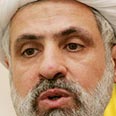
Hizbullah: Only 10 percent of our arsenal fired at Israel
Organization's Deputy Secretary-General Sheikh Naim Qassem says in interview with al-Sharq al-Awsat newspaper, 'we are facing transitory stage and reorganization of operation method which will only be determined in a while'; adds: It is still unclear what our stance will be if Israel fails to withdraw from Shebaa Farms
"We are facing a transitory stage and a reorganization of the operation method which will only be determined in a while," he said in an interview published Sunday morning in the London-based Arabic-language al-Sharq al-Awsat newspaper.
"This is a stage which entails studying the method which the resistance will operate in. Therefore, it is still unclear what our stance will be if Israel fails to withdraw from the Shebaa Farms. We are in a situation of learning after all the developments. The situation has changed and there is no other option but to learn," Qassem added, admitting that his organization was in fact facing a new situation.
During the interview, however, he stressed that his organization would continue to adhere to "resistance activities," as well as to the concept of "withstanding the Israeli danger."
He added that Hizbullah would not halt its efforts to increase its military power, in spite of the steps taken to prevent the group from doing so, and in a bid to supervise Lebanon's activities.
'No plan to fight against US'
Qassem added that his organization possessed more than 8,000 rockets, some of which it fired at Israel during the war.
"We can stand strong for many months. What we fired at Israel is comparable to 10 percent of our arsenal. We are in no need of accelerating our military capabilities. Each side thinks about boosting its weapons arsenal, but I do not believe that weapons are our problems," he said.
During the interview, Qassem admitted that his organization has no plan to attack and fight against the United States, and stressed that his organization's has been limiting its military activity in order to fight Israel, "only on Lebanese soil and not anywhere else in the world."
As for his conclusion following the war that he believes his organization won, he was asked: If this is a victory, why are so many in Lebanon condemning it?
"In Lebanon everything has to do with the political dispute between two groups. There is a group that believes Lebanon's power is the power of resistance, and there is another group that evaluates Lebanon's power according to its international diplomatic ties," he said.
