


No religious differences
Despite their religious belief, they have come out of closet and built happy relationships with secular partners. Now, with a violent storm swirling around pride parade, these couples are more convinced than ever that parade must take place. 'I am disappointed with my community, the national religious camp,' says Aya, a religious woman who lives with a secular partner. And how is their personal co-existence? Much more successful
"This is the first time,” says Yannai Gorni, “that I am afraid of the Pride Parade.”
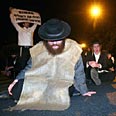
He has already decided that he won’t wave the community’s flag until he joins up with his friends. He fears for his own life, but he is even more afraid for his partner, Aviad Doron, who carries two conflicting titles: he is religious and openly gay.
“I am scared that something will happen to him because he wears a kippah (yarmulke),” admits Gorni. “Last year even the police securing the parade gave him a hard time. They did not believe that he could be a homosexual and wear a kippah. It took a lot of time until we were able to convince them to let us in.”
Despite the fear, and despite the differences of opinions that crop up around the peaceful island that they have managed to create, there is one fact on which they both agree: they must march in this parade. “The parade in Jerusalem is less provocative, there are no floats or dancers,” they say. “It is a danger to democracy to cancel a parade in a place that has a thriving homo-lesbian community.”
The second couple that we interviewed for this article had the same opinion. A lesbian couple that has succeeded in building a beautiful relationship that bridges the gap between religious and secular.
In their home they have learned to be flexible and to avoid the pitfalls that plague other religious-secular couples. Now they are looking out on the violent storm that is threatening to cause strife between the religious and homo-lesbian communities, and they are amazed that society has not been able to cope with what they lovingly contend with on a daily basis.
According to them, there is no need to choose between two worlds: one can be religious and gay, and you can be a religious lesbian who lives with a secular lesbian.
A Stranger in the Synagogue
Gorni, 26, is a lawyer, and Doron, 30, works in high-tech. The Jerusalem couple met four years ago at the homo-lesbian student club of the Hebrew University.
“When we first started dating, I thought that it would be very hard to live with a religious man,” Gorni relates. “Surprisingly, religion is not the focus of our arguments, and we do argue."
Gorni’s secular parents object to the pride parade in Jerusalem. “They said that we should be content with a parade in Tel Aviv, and must not stand on the principle. Aviad’s parents actually understand. Last year, his mother even said that she would come to the party after the parade."
Gorni, who has learned about religion from his partner, is amazed at the violent religious opposition to the parade.
“It angers me because I know that this is not the religious approach. In the past, before I met Aviad, I saw things differently. I thought that if you were religious, you were automatically against homosexuals, lesbians and the parade. Today I know that religion is not the problem. The problem lies with people who interpret it incorrectly."
"There is a lot of hypocrisy in this battle,” says Doron. “In Jerusalem there are soccer games on Saturday, but it is easier to fight against gays than soccer fans."
Doron struggled since the age of twelve between religion and his sexual preference, until he realized that he could live peacefully in both worlds.
“As soon as I decided to come out of the closet, I realized that there was no reason to run away from religion,” he says. “I knew that I wanted to continue living a religious life. I was afraid of the reactions of my Orthodox friends, but my fears were groundless.”
And how do you manage with your secular partner?
“At home we keep Shabbat. Yannai has a room where he can do whatever he wants. We have traditional Shabbat meals. My faith forces Yannai to compromise a lot, and sometimes he is frustrated that we can not spend Shabbat the way that he would like to."
G-d Willing
Aya, 28, belongs to the national religious camp and lives with Yael, 32, who is secular. She has never liked the pride parade that take place in Tel Aviv. “It is an immodest parade,” she explains, “it is not appropriate for religious people.”
Yael always participated in the parades, but Aya stayed away. “In the beginning, I did not mind that there was no parade in Jerusalem. I thought that it would be easier to have it somewhere else. But now everything has changed. Now we have to have the parade in Jerusalem, because it is a democratic Act."
"The haredim have the right to democratically act against anything that they deem an insult to their sensitivities. There are ways to go about it. But as soon as they become violent it becomes illegitimate,” she adds.
Aya: “I am more disappointed in “my” community, the national religious camp. I am assuming that they have political reasons for getting involved. We are not talking about a halakhic issue. There is no prohibition to marching. The leaders of the religious community are using it for political gain.”
Aya and Yael met five and a half years ago in a lesbian forum on the Internet. They have been living together for four years. They belong to the religious lesbian organization “Bat Kol”, and on the door of their house is a sticker that reads “Proud to be religious”.
In their house, located in a secular community in central Tel Aviv, they run an Orthodox home. They keep kosher, use a hot plate on Shabbat and have a Shabbat clock. “I agreed to this, because I love Aya,” says Yael, “Aya is religious and being religious is not just a technical matter. It is a matter of faith.”
Will you march in the parade?
Aya: “G-d willing.” Yael: “And even if He doesn’t.”
