



Sea of love
David Ofek’s 'The Hebrew Lesson' presents lives of new immigrants who want to learn Hebrew. Even though reality is not easy or always pleasant, result is full of compassion
There are not only Jewish immigrants learning in Ulpan Gordon in south Tel Aviv, any immigrant can learn Hebrew. That is how immigrants from China, Germany and Peru gather together in the teacher Yoela’s class with Jewish immigrants from Russia, England and Romania.
And here are two Zionist stories, model 2006: A Chinese woman meets an Israeli man on a Chinese mountain abounding in greenery. They fall in love. She leaves her country, language, and career and follows her love to a harsh Middle East country and a Semitic language that she can hardly speak.
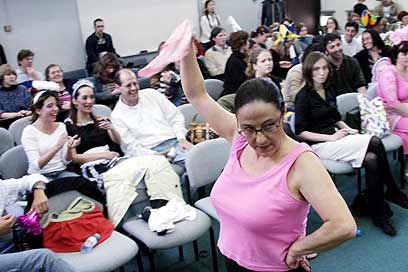
Scene from "The Hebrew Lesson" (PR Photo)
And a Russian Jewish lawyer, who leaves a prosperous career and becomes a floor cleaner in a Tel Aviv restaurant, in a desperate attempt to be a father to his little girl from whom he was separated, when his ex-wife brought her to Israel.
David Ofek presents in “The Hebrew Lesson” slices of life of real people in such a simple and natural way, that the viewer feels that he is part of that reality. It is not an artistic, sophisticated, prettified representation - but an analysis of humanity itself. And is there anything better to say about a documentary film?
The hearts flew like seagulls
All of Ofek’s characters are basically dealing with a struggle to realize love. The teacher, a single mother, with daily hardships, is a mother earth type who envelops her students with waves of love, a pure love of mankind that is oblivious to nationality or religion. In response to her student’s protests against her constant demands, she bursts out in tears and runs out of the room. “You have to show love through deeds. They should show me love!”
Dong-Dong, a professional moviemaker, is a young Chinese woman who came to Israel for love and in my opinion is wonderful. Dong-Dong looks around with the open eyes of one who comes from the outside and sees inside (she describes Israeli society as “Bchach…Bchach” which Yoela translates as “cactuses”).
She wants to make a film about the foreign Chinese workers and to show them - these invisible people - as human beings. And what makes a person visible if not love? But the workers’ wounds and distress dash her hopes. The need to deal with their survival overrides her desire to deal with their love. And thus she finds herself in the task of filmmaker-social worker.
She cries as she reads from the poetry of an illegal Chinese worker who is in jail awaiting deportation: “The hearts fly like seagulls. How great are the dreams in the unknowing sea”.
Dong-Dong is not the only Chinese woman in Yoela’s class. There is also Chin. Here I am obligated to retell a small revelation: Half a year ago I was at a hotel in Eilat. An exceptional couple caught my eye, a silver haired Israeli gentleman with a heartwarming Chinese woman. The two did not hide their mutual affection. It was so sweet and surprising to see this lovely couple again on the movie screen.
In the film, the questions that I had then in Eilat became clear. Evidently, Chin came to Israel as a foreign worker and worked as a maid for Ehud, an older and established Israeli. In the beginning she was suspicious of his affection, but soon she learned “that he really wants what is best for me”.
They traveled to China together and married in a bright and colorful ceremony with her family. Whoever wants to see in this couple another example of an older Israeli man who finds an Oriental slave will be disappointed. It is enough to look in his worried eyes while he is waiting for his wife at the airport - while the border police are delaying this “strange” Chinese-Israeli phenomenon - in order to understand that, no matter how banal, it is a love story.
And we have not yet spoken about Anabel, a beautiful German woman who at the end of her years in Israel with her Israeli partner knows that it is “too hard”; and we have not discussed Marisol, the frenetic Peruvian young lady, who has an unwanted pregnancy with her Israeli boyfriend.
And we have not spoken about the Russian Sascha, who in one sentence says all there is to be said about the new individual Zionism that everyone in the ulpan shares: “My daughter is in Israel..I am in Israel!” Indeed each of them left - for a lover, a husband, a daughter- their family and country, and chose this harsh foreign land with an impossible language.
David Ofek causes us to have this strange experience: While everything is so difficult and sad - from the Hebrew syntax to the obstinacy of officials at the Interior Ministry; from the sight of the suffering of the foreign workers to yearning for the world they left behind; from the racism of the immigration laws to the dwindling of relationships.
Yet in the midst of all this, the characters in the movie - the teacher, students, workers, and policemen – share a type of all-embracing human brotherhood. They are all entitled to compassion, and they all emanate compassion.
