


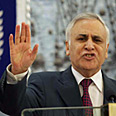
Katsav
צילום: חיים צח
Mazuz explains plea bargain decision
Tells High Court that Katsav case lacks enough solid evidence, making conviction at trial difficult
The primary reason the Attorney General's office opted for a now-controversial plea bargain with suspended president Moshe Katsav instead of pursuing the charges in the original indictment in a court of law is due to the lack of solid evidence, AG Menachem Mazuz explained to the High Court on Thursday.
Mazuz told the court that there was no doubt that Katsav and complainant A had an intimate relationship. According to the attorney general, even Katsav's attorney conceded this during a hearing, claiming that this relationship was completely consensual and not coerced.
Nonetheless, he said that there was difficulty in determining the nature of the relationship "at a level of certainty necessary for a criminal trial.
"A occasionally contradicted herself and some of her statements were contradicted by other witnesses." Among these other witnesses, said Mazuz, were even sources close to A, who at times contradicted her testimony directly.
The attorney general emphasized that as early as investigations in January 2007, there were doubts as to A's version of events "that reduced the scope of the original indictment against the president regarding her."
The discrepancy between the original indictment and the plea bargain, said Mazuz, derived from new information presented during a later hearing for Katsav.
"The new evidence (from the hearing) wasn't able to turn the tables completely, but did contribute to a change in the earlier indictment…This was not a U-turn or an unsubstantiated move. The process evolved over months.
"It turned out that the State's stance in January (directly after the publication of the indictment) was based on the fact that the indictment would be based on the testimony of two primary complainants (A from the President's Office and A from the Tourism Ministry).
"However, after the testimony of A from the President's Office was not included in the indictment, it became more difficult to substantiate the testimony of the other complainant from the Tourism Office," Mazuz explained.
