


Higher education reform underway
Shochat Committee presents recommendations to PM in attempt to improve Israeli higher education, research. Proposal includes putting $585 million back into education budget; raise in tuition with loans payable over course of 10 years
The Shochat Committee for the reform of higher education recommended raising university tuition to $3,500 a year on Monday.
Presenting its recommendations to Prime Minister Ehud Olmert, Education Minister Yuli Tamir, and Finance Minister Ronnie Bar-On, the committee recommended that the sum of $585 million, which was cut out by previous governments, be returned to the higher education budget.
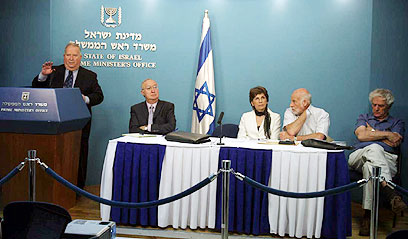
Shochat Committee (Photo: Gil Yohanan)
The committee was assembled in order to provide a solution for the economic and academic crisis Israeli academia has faced, and to encourage excelling research, increase accessibility and prevent a brain drain.
The Shochat Committee's recommendations include:
- A $585 million rise in the budget for higher education institutions per year over the course of six years, with $350 million provided by the state.
- A $187 million investment in rehabilitating and strengthening university research centers, doubling the budget of the National Science Foundation to $117 million, investing $23.4 million in the establishment of a foundation for bio-medical research, and $3.5 million to establish a foundation for research in humanities.
- The establishment of a system which would provide significant payment and benefits for excelling researchers and lecturers in order to prevent a brain drain, and the recruitment of leading scientists from abroad.
- Adopting an innovative model to regularize tuition and set aid systems for students in order to increase accessibility to higher education and lighten the burden of payment during studies.
The yearly tuition will be composed of two components: An initial sum of about $1,300 at the beginning of the academic year and a subsidized bank loan of $2,100 to be paid over the course of 10 years, only after the student has graduated and is earning a monthly net salary of at least $1,242.
The committee further recommended "unprecedented aid systems for increasing accessibility", including providing scholarships to students from weaker layers and supporting students from lower socio-economic backgrounds in paying the initial tuition fee.
Some $70 million will be put toward such scholarships.
"This is the most comprehensive and thorough reform that was ever proposed to strengthen the higher education system in Israel," said Avraham Shochat, the committee's head and former Finance Minister.
"Implementing this reform is like injecting oxygen into a system that is suffering severe deterioration," Shochat added.
Students threaten not to open school year
Immediately after the committee's recommendations were released, about 60 students demonstrated outside the Prime Minister's Office, carrying signs with alternative recommendations.
Itai Shonstein, chairman of the National Student Union, declared on Monday afternoon that "the next school year will not open. We will fight in an unprecedented manner if the Israeli government lies to the student public again."
Tomer Oved, chairman of the Israeli Students Organization, added, "I don't know what everyone is getting so excited about. The committee's recommendations were known in advance. The Israeli government must honor its commitments to the student public."
Prof Shosh Arad, head of the Council of Presidents of Academic Colleges, announced that the council planned to launch a struggle against the Shochat Committee recommendations.
"This report ignores the greatest threat on Israel's higher education – the privatization of the public academic system… The committee ignored the blatant attempt by private elements in the government to privatize the Israeli higher education…
"It appears that the Israeli government is trying to renounce all its civil duties toward the State's citizens. From health to education, Israeli citizens will have no choice but to turn to the private market. The destruction of the public higher education will make academic education available to rich people only," she said.
