


In the footsteps of Saul, Ahav, and Jezebel
The pastoral serenity of Mount Gilboa does not reveal the nature of the biblical stories that occurred here and that ended in dramatic and cruel deaths. The tour guides from the Yad Ben Tzvi Institute take us on a tour of the scenic paths and breathtaking observation points, in the footsteps of Saul, Ahav, and Jezebel
This is the place where Saul approached a sorceress to seek her advice, and went out to battle with the knowledge that he was marching to his death. Later on, King Ahav and his wife Jezebel each died a violent death because they coveted the vineyard of Naboth in Gilboa, as prophesized by the prophet Elijah. These deaths, however, as we will see during the remainder of the tour, were not the end of this prophecy, which was fully realized.
On our way
We will begin the tour of the Gilboa at the bird’s-eye lookout on Mount Barkan. At the end of the winter, multitudes of irises bloom here, but the view from here is beautiful and impressive all year long.
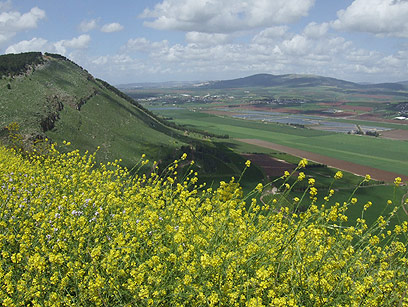
Beautiful scenery year round (Photo: Rotem Dekel)
From the lookout you can see the unique structure of the Gilboa, which is a long extension that continues north from the Shomron Mountains; at its feet are the communities of the Ta'anach region; and southwest is Jenin. In the valley to the west there used to be a path that went to the Shomron arriving in the Dotan valley.
A path marked in red goes down from the lookout westward, passes an ancient wine press and crosses the road to another lookout over the Harod valley. The valley below us is where the ancient Midianites spread out “They would come up with their livestock and their tents, swarming, as thick as locusts; they and their camels were innumerable” (Judges 6:5). It is possible that this is where Gideon, a man of Ofra, gathered thousands of volunteers for his army, and suggested that all who were frightened return home. Afterwards he conducted his final selection of fighters in the “water test” at the Harod spring at the bottom.
We will continue on the red path and return to the parking lot on Mount Barkan, and travel a few more kilometers on the scenic road on the Gilboa (route 667). A little after the Vinya Cohen Lookout we will turn right towards Mount Saul. A walking path marked in green surrounds the summit, which you can reach on different paths from the parking lot. Along the path there are resting spots and lookouts over the views of the valley and Mount Tabor.
A desperate attempt to escape
What brought Saul and the Philistine captains to fight here, far away from Judea and Philistine? Was it for a grasp of the fertile land that was still inhabited by Canaanites? Was it to control the important road that passes through the Jezreel Valley? It is not clear. However, according to the last chapters of Samuel I, the armies of Israel and Philistine fought in the valley, between what used to be Ein Jezreel, today Kfar Sulam, which you will see on the slope of Givat Hamoreh at the end of the tour.Saul, frightened, hesitant, and chasing after evil spirits, tried to receive any sign about the fate of the battle “but the Lord did not answer him, either by dreams or by Urim or by prophets” (Samuel I, 28:6). From Mount Saul you can look out at the road that a dejected Saul took on that fateful night, along the valley, right between the Philistine tents, to the path to Mount Tabor, to the sorceress at Ein Dor.
The answer, as you will remember, was very difficult. There was no consolation for Saul, and yet he made his way on the dangerous road to his army, and went out the next morning leading his men to a battle, from which he knew he would not return. At the end of the battle, in a desperate attempt to flee the Philistine’s chariots, Saul and his men climbed the rocky, hilly Gilboa, but it was for naught. Before the enemy’s arrows reached him, the king fell on his sword.
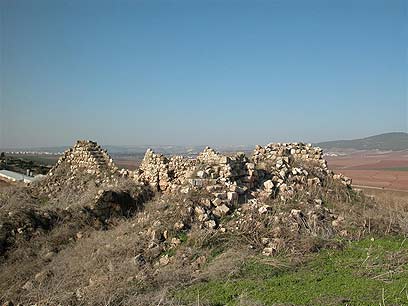
Here stood the vineyard Ahab coveted
“O hills of Gilboa — Let there be no dew or rain on you, or bountiful fields,” lamented David on the deaths of Saul and Jonathan. The sight of the Gilboa, green and rich with vegetation, do not reflect David’s curse, yet the surrounding scenery clarify and demonstrate what occurred here 3,000 years ago.
We will return to the scenic path and continue on it until the junction, where we will turn onto route 675 to the Jezreel junction. Turn right and then another immediate right into the Tel Jezreel parking lot. Jezreel was the alternate capital city (in addition to Shomron, which was Sebastia) of the kingdom of Israel in 900 BCE.
The mistake that cost them their lives
On the slopes of the barrow, across from the amazing scenery, there is a monument in memory of the soldiers who perished in the valley during the War of Independence. Nearby, was the vineyard of Naboth the Jezreelite, which Ahav, king of Israel, coveted, and probably even more so, the land on which it was planted. When his attempt to acquire the vineyard failed, the queen Jezebel entered the picture.
In order to transfer the vineyard to Ahab, Jezebel staged a trial where Naboth was falsely convicted. Naboth was sentenced to die and was stoned to death. Elijah the prophet predicted a violent death for Ahab and Jezebel. “The dogs shall devour Jezebel in the fields of Jezreel” (Kings I, 21:23)- these are the words of the horrifying prophecy.
Let us skip a generation ahead: The king of Israel, Yehoram son of Ahav and Jezebel, was wounded in the war against Aram. While he was delayed here in Jezreel with his friend the king of Judea, the commanders of the army in Ramat Gilad crowned Yehu son of Nimshi to be king (as told in Kings II, 9). Yehu did not waste any time and rushed to Jezreel. The watchman on the tower in Jezreel noticed him coming from the east and identified him as one “who drives wildly.”
The kings went out in haste to greet him - a mistake that cost them their lives: Yehoram was killed in the area of Naboth’s property, Ahazia, king of Judea ran away, was captured and killed, and in the end, Yehu entered the city, where Jezebel was observing the scene, until her death which was according to the prophecy of Elijah.
After this dramatic story, in order to free ourselves from this difficult impression, we will go down the pleasant path between the orchards of Ein Jezreel, which in Arabic is called “the dead springs”, for its tendency to dry up, but even when there is little water, the pastoral view and shade of the trees is a good place to end the tour.
The tour was arranged by Yad Ben Tzvi Institute .
Additional articles in the series “Traveling with the Bible”: King David in the Judean Lowlands, Philistines Upon You, Samson, Here Lives the Jebusi family, A Song for Gideon,
In the footsteps of King Saul.
