


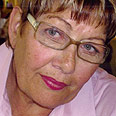
Evelyn Rishati
The kindness of (former) strangers
When Evelyn Rishati was asked to ease new immigrant Irina Potlov’s absorption, she jumped at the chance. Although the two women didn’t speak the same language, they now consider themselves good friends
Benevolence has always been an important value for Evelyn Rishati, an Acre resident. After all, she was a nurse for forty-six years.
Thus, when representatives of the Jewish Agency’s “Babayit Beyachad” (literally, “at home together”) – a program designed to help absorb new immigrants and to alleviate their social isolation by pairing them up with veteran Israelis – approached her about assisting new immigrant Irina Potlov, Rishati jumped at the chance.
“When I called her the first time, Irina didn’t understand me, and I didn’t understand her, because of the language,” Rishati reports. “And so, we tried again and again over three days. We didn’t give up. We were determined.”
Their determination paid off. Today, the two women share a close emotional bond. “The first time we met, she came over with homework she had received in ulpan (Hebrew language instruction),” Rishati recalls. “But soon thereafter, I decided to teach her practical things, which will broaden her horizons.
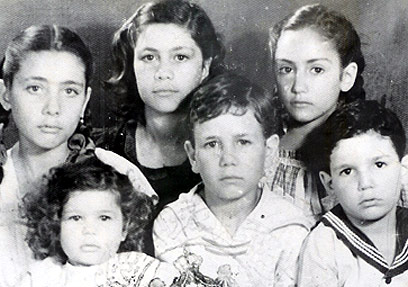
Evelyn (first on the left). First days in Israel
“For instance, we traveled to the mall by bus, and I explained the route to her. And in general, even when we didn’t have the words, our body language served as a means of communication.
“Three weeks ago, I went over to her and her mother, in order to see the house in Acre that they had recently moved into. She told me that I was her first guest. I bought her a hamsa. Of course, they don’t exactly understand that sort of thing, but she was pleased.”
The relationship works both ways. “Two weeks ago, my mother passed away,” Rishati says. “Irina came to console me, and that gave her an opportunity to become acquainted with our mourning customs.
“And that’s how we slowly, slowly build up our friendship - like when one embroiders a needlepoint, another thread and another color and another corner, until it’s transformed into a whole work.”
Immigration and absorption
Rishati, a former runner-up to Miss Acre, has her own story of immigration and absorption. She was born in Iraq and moved to Israel with her family when she was twelve and a half years old. “Without the language and unable to communicate,” she stresses.
During the first three months after their arrival, her family spent an entire winter living in a transit camp (ma’abara). Their rickety tent was no match for the cold, and Rishati still remembers the hunger.
Yet, Rishati recalls that even during that first year, she helped other newcomers. “Romanian olim (immigrants) arrived at the ma’abara, and I taught the children the Hebrew that I already knew,” she recollects.
At age fifteen and a half, Rishati was accepted to a nursing program but was deemed too young to attend the courses. However, the director recognized the young girl’s earnestness and admitted her to the program. Thus, by age seventeen and a half, Rishati was working as psychiatric nurse in Mizra Hospital, where she was eventually promoted to more senior positions.
“When Irina was desperate,” Rishati states, “I told her my story, and that encouraged her. I said to her that even when it’s difficult, one needs patience.”
Potlov and her mother – a now-retired physician who was well-known in Russia – arrived in Israel a mere five months ago. Neither Potlov nor Rishati can believe that they’ve only known each other for two and a half months.
“Evelyn is an excellent woman,” Potlov gushes. “Beautiful; a walking encyclopedia; and mostly, she spends all her time thinking of ways to help. Evelyn is my first teacher, and the Hebrew that I’m speaking is because of her.
“I don’t know what I would’ve done without her. I adore her.”
Recently, Potlov, who was a lawyer in Russia, opted to switch careers and study nursing. Rishati’s influence in that decision is obvious.
“I’m so proud of her,” Rishati declares. “I see her as a continuation of myself. Giving is really worthwhile.”
For more information about the program - click here
