



Tricks of the trade
Big bad corporate world tries to redeem image by launching array of socially conscious campaign, cloaking shrewd marketing as newly found social responsibility. Some companies even manage to do some good
Successful Swedish fashion chain H&M, which operates some 1,500 stores in 28 different countries, announced recently it will be launching a new collection aimed at increasing AIDS awareness and raise funds to fight the disease.
The collocation, named "fashion against AIDS" is backed by many musicians, artists, celebrities and fashion designers.
The increasing awareness to mankind's need to save the planet on one hand and the concept of the "big bad corporate world" on the other, has led the latter – and its array of PR firms – to try and redeem its collective image. The H&M campaign is another initiative taken to that end.
With the growing trend of consumers criticizing – and in some cases banning – companies which they feel "stray" form certain values, more and more companies choose to market themselves as socially and environmentally conscious.
When thinking about the concept of a socially conscious ad campaign, one immediately diverts to Benetton, which recognized the power of making a strong social statement back in 1989, when it launched its United Colors of Benetton campaign, featuring multiethnic models wearing the company's cloths as a statement against racism.
Benetton's ads became synonymous with controversial statements in the years to come, featuring images of poverty, illness, physical deformities, same-sex and interracial couples and any other burning issue the company could come up with.
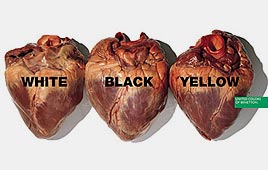
Synonymous with controversy. Benetton (Archive photo: Benetton PR)
The controversial ads were banned in many places; but Benetton forged on, using its campaigns to push a social message of peace, tolerance and equality.
Steps to a conscientious strategy
An ad campaign featuring a strong social message has long been considered a proven marketing strategy. Companies often cease appealing to their potential client base directly, opting to base a products on a common vision or a shared value; turning them into a social entity – one the customer can identify with.
Socially conscious campaigns usually follow one of three avenues: Pushing a social issue not directly connected with the company's products; marketing products as part of the company supporting a named cause; and re-branding companies which have a controversial image by associating them with a social agenda.
Body Shop, for example, chose the first avenue, launching a campaign against child abuse with the double-entendre title "Kids are unbeatable."
The strategy marketing products as means of supporting a cause can be best illustrated by the launching of the "Product Red" campaign, created by Bono and Bobby Shriver, Chairman of DATA - an advocacy organization dedicated to eradicating extreme poverty and AIDS in Africa.
As part of the campaign, companies like American Express, Apple, Converse, Motorola, Gap, Emporio Armani, Hallmark, Microsoft, and Dell announced that a percentage of all profits made off the sale of the products they included in the campaign, will be donated to the DATA AIDS funds.
Changing perceptions
The third kind of socially conscious campaigns, where a company tries to re-brand itself or its product as "socially friendly," is usually reserved for businesses suffering from a negative public image.
These companies try to change consumer perception by advertising a new, "green" agenda: The UK's BP energy company, for example, launched a 2007 campaign in which various people spoke about the oil conglomerates' responsibility to protect the environment. A caption soon followed, telling the viewers that BP has invested $8 billion in researching alternative energy sources in the past 10 years.
Israel is no stranger to socially conscious campaigns as well: The CIBC Bank's Israeli branch launched an ad campaign in late November 2007, saying "On December 5, we won't be making a dime". The bank told its customers that all commissions made that day will be donated to various children's charities.
Amit Mashiach, deputy director of client relations at McCann Erickson, has a few more examples to offer: "Bank Hapoalim is the only brand name is Israel which is completely identified with a social agenda under which it sponsors various causes.
"Cellcom launched its 'Cellcom Volume' and is using it to build youth music centers in rough neighborhoods, and has talent scouts in those areas," he continued; "and Dor Alon is now advertising the parks its cultivating near its gas stations."
The latter's case, however, is just an image change for now. "Their agenda," he pointed out, "is still the same."
