


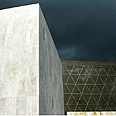
Munich’s Jewish Museum celebrates 1st anniversary
One year after it opened, museum tries to 'offer something for everyone,' succeeds in attracting visitors from all walks of life
The museum itself is built in a very modern, clean design. Visitors stand outside the large glass windows that surround the entire ground floor and read the various famous quotes and sayings printed on the glass. The inside is decorated in a very no-frills manner with lots of stone and concrete.
Inside, the museum covers three floors between the permanent and temporary exhibits. There’s a vegetarian and dairy café in the lobby, not kosher. A large gift shop also offers visitors the chance to purchase books and judaica. One of the gift shop workers said that the most popular items are books on what Judaism is about as well as Jewish history, and on the judaica side, menorahs.
The museum’s director, Bernhard Purin, said that it was important to “show the diversity of Jewish culture.” He said that the museum intentionally chose not to focus on the Holocaust in order to “focus on Jewish life” in Munich.
In the museum’s permanent exhibition is an interactive map of Munich with photos highlighting the history of various places around the city and their connection to the Jewish community. Running lengthwise along one wall, a timeline of Munich back to 1229 details various events that befell Jews there. Very few of the events are happy ones, a testament to the difficulties of Munich’s Jewish community. Another display holds a Passover seder plate, a Hanukkah menorah, and other items in an attempt to explain about various Jewish holidays and customs.
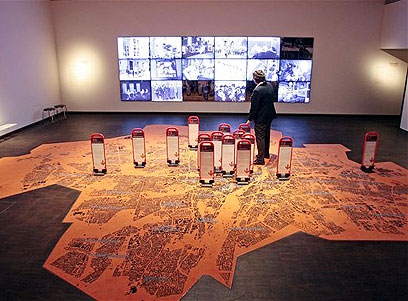
Interactive map (Photo: AP)
Unlike in many other museums, Purin said that his staff is encouraged to interact with the visitors. Yaniv, a religious Jew and student from Munich, works as a guest assistant at the museum and said that his job is to “help others learn about Jewish life and culture.” He said that most of the museum’s visitors are very open and wiling to learn. Outside the museum, Yaniv, whose grandfather was in several camps during the war, said that Jewish life in Munich can be difficult, “especially when you’re religious,” but that Munich is a nice city in which to live.
A methodology that appears to work
The upper floor of the museum hosts the different temporary exhibits. Currently on display are several pieces of contemporary art from the private collection of Heinrich Thannhauser. Computers with interviews, photo exhibits, and more are available for visitors to explore, as is a library featuring books in several languages on Jewish life, history, and religion. Purin said that the museum “tries to offer something for everyone, and while they’re here they can also see our main subject.”It’s a methodology that appears to work. Katarina, from the Munich suburb of Wörthsee, came to the museum with her husband and daughter specifically to see the Thannhauser exhibit. She said that it was good not only to see the artwork, but also to read about the life of Thannhauser and his family. As for the museum’s permanent exhibition, Katarina, who has a family member studying in Tel Aviv, said, “I read a lot about history and about the Third Reich, and they have here (at the museum) very good information.”
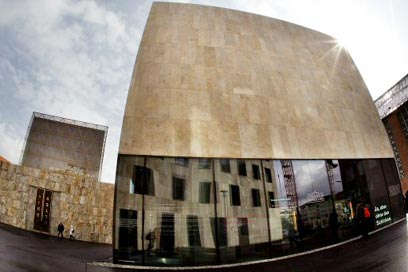
Museum's exterior (Photo: AFP)
Another couple visiting the museum, Dr. Johann and Anne Weber from Affing, was not quite as satisfied with the museum. They both agreed that it was “well presented, but it could be greater, larger, more.” Anne also said, “We read a lot about the (Jewish) story, but it is a situation that is not always easy for us German people.”
Purin said that nearly 100,000 people visited the museum in its first year, reaching that mark just four days after the official date. He said that of the 300 or so visitors per day to the museum, some 70% of them are locals from southern Germany. During the city’s annual Museum Night, when museums stay open late into the night and a single ticket gets you access to all of Munich’s museums, the Jewish Museum alone saw about 4,000 visitors.
According to Purin, the museum has several more temporary exhibits planned for the upcoming years. Three exhibits will each focus on a place of exile, the first being Istanbul, then Tel Aviv as part of the city’s 100-year anniversary, and finally Washington Heights in America.
While Munich will celebrate this year its 850-year anniversary, the Jewish Museum will feature an exhibit on the “City Without Jewish Life,” marking a period of more than 400 years when Jews were forbidden from living in the city.
