


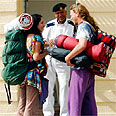
Israeli tourists at Sinai border
צילום: ג'ו קוט
The Israeli traveler – laws to live by
'We feel Israelis do not always abide by local laws, when they travel they sometimes forget themselves', Foreign Ministry official says; warns travelers that ministry does not have power to release prisoners in foreign countries, so they should behave
The Ministry of Foreign Affairs is in a constant state of readiness for overseas phone calls about Israeli travelers. Not one day goes by without at least two reports of Israelis who have been arrested for different offences in countries worldwide.
"We feel that Israelis do not always abide by local laws, and when they travel overseas they sometimes forget themselves," said Amnon Kalmar, who heads the department handling Israeli cases abroad. He is in charge of coordinating the activities of Israeli embassies worldwide when handling Israeli travelers who have run into legal difficulties.
According to Kalmar, Israelis have been arrested for every possible reason, including border trespassing, working illegally, residing illegally, drug trafficking, robbery, jewel trafficking, threatening stewardesses, and assaulting officers or government employees.
Trouble brews when the Israeli finds himself behind bars in an out-of-the-way prison at the ends of the earth, yet is certain that one phone call to the nearest embassy will cause the ambassador to drop everything in order to convince the local authorities to release him at that instant.
"The public feels that when an Israeli is detained the State will use any and all operative measures in order to ensure that he is released. There is a big gap in expectations here and the public must understand: We do not have the power to release prisoners. Once an Israeli is detained somewhere we have a problem. We cannot intervene in the legal procedures of foreign countries," Kalmar added.
When an Israeli is detained overseas he or she is primarily subject to local law. The foreign country is obligated to inform the nearest Israeli embassy about the citizen's arrest, but the person detained also has the right to request that the embassy not be informed.

Careful: No Israeli embassies on Caribbean, Pacific islands (Photo: Abigail Uzi)
Once the consul receives word of such an arrest, he should contact the detainee by phone. According to procedure, the consul will then provide the Israeli with a list of local lawyers. In the past the consul would also recommend a good lawyer from the list, but due to complaints about the recommended lawyers, the ministry has decided to refrain from giving such advice.
"In the event of an arrest or legal mishap, the first thing that should be done – officials from the ministry's diplomatic legal department say – is to employ a good lawyer to get you out of trouble. Of course, a good lawyer costs a lot of money, so one should think twice before getting into trouble," Kalmar continued.
'Call Condoleezza!'
All Israeli detainees are entitled to a visit from the consul within two weeks of their arrest, however the ministry warns that some countries, like New Zealand and all Caribbean and Pacific islands, do not have Israeli embassies and therefore such a visit may take months to come.
The predicament worsens when an Israeli is arrested in a country with which Israel does not have diplomatic relations, such as Cuba. In this case it would be the Canadian consul who pays the visit, as representative of Israeli interests in Havana.
During the visit, it is the consul's job to make sure that the Israeli is not being discriminated against, relatively to the other prisoners, and that the conditions in which he or she is being kept are appropriate. Sometimes the embassies attempt to intervene in the Israeli's favor on these matters, but that doesn't always help.
Because of the high expectations Israelis have for their embassies, many consuls have reported receiving late night phone calls from detainees or their parents demanding immediate release. On consul reported such a phone call from a mother yelling for him to "get Condoleezza Rice on the phone and demand that she release my son from prison for working illegally in the US."
Another enraged mother demanded that the consul bring up the issue of her son, detained for selling artwork illegally in an American mall, at Israel's next meeting with US President George W. Bush.
As a rule, consuls are not required to become involved in legal procedures unless the matter becomes serious or an anomaly occurs. For example, Israelis have been caught with bullets mistakenly left in their bags from their reserve service. In such cases, the ministry attempts to explain to the local legal factions that the mishap was a consequence of a lifestyle unique to Israel, and since the Israeli was clearly not intending to cause harm, tries to help him. However the ministry has entreated Israelis to shake their bags out well before leaving the country.
Another important recommendation is to plan ahead, and read about the laws and customs of the destination one is headed towards. In Africa, for example, certain medications are considered illegal drugs. And in India one should never dress inappropriately when visiting the local temples as this could also lead to arrest.
