


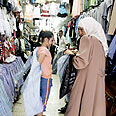
Arab family during back-to-school shopping
צילום: איי אף פי
What about Arab textbooks?
Poor achievements of Arab students have to do with inferior Arabic-language textbooks
One of every four students in Israel is Arab – but what do Arab pupils study? What kind of textbooks do they use? Just like everyone else in Israel, Arabs study the subjects included in the Education Ministry’s curriculum, yet while Hebrew-language pupils get the most up-to-date high quality textbooks, Arab students use materials that are reminiscent of Third World countries.
Many Arabic-language textbooks have been translated from Hebrew – therefore, Arab pupils use books that have been especially designed and planned to be used in Hebrew-language schools. Below are several examples of this:
- A history textbook deals with the ancient people who lived in the region. The Babylonians and Persians are among those mentioned, along with the Israelites, Greeks, and Romans. Yet the Arabs are not mentioned at all.
- A geography textbook for junior high includes maps that show the population growth in Hebrew communities. All sorts of communities are mentioned in the book, but not even one Arab community in Israel is included.
- A biology textbook deals with the importance of water to the human body. The story begins with a group of Jewish troops marching in the desert before the State of Israel’s establishment…
The translation projects take several years, and when those books, which were never suitable for the users anyway, are published, they are often no longer relevant. While most textbooks in Hebrew are updated every year or two, it isn’t rare to find an Arabic textbook published in the 1990s and even 1980s. These books, translated from Hebrew, are not suitable for Arab students, who cannot identify with their content. The subsequent alienation undermines their ability to succeed.
Current-day textbook in Israel and developed countries compete with the electronic and digital media. Therefore, Hebrew textbooks are printed on high-quality paper and are filled with color photographs and various forms of intellectual stimulation such as tables and crosswords. Yet Arabic textbooks lag far behind. Most of them are printed in only one or two colors and in smaller fonts, in order to save money. Not only are Arabic textbooks of poor quality, many of them are printed illegally and forged. This makes the quality even worse. For example, in one textbook students are asked to mark the red circles, yet sadly those circles happen to be blue.
These terrible textbooks have great influence on Arab students’ quality of education. The books are not inviting, and even repel Arab students. Those books simply do not reflect the life or world of the students. These textbooks, which are reminiscent of Hebrew books from 40 years ago, create a sense of revulsion and alienation.
The relatively poor results of Arab students in national and international tests have to do with the terrible condition of the Arab education system in Israel. The discrimination against Arab pupils is also manifested when it comes to textbooks. Therefore, the Education Ministry, and possibly other agencies and private groups, should dedicate more efforts and resources to improving the quality of Arabic-language textbooks.
The writer heads the Indimage organization, which focused on education in Israel’s mixed cities
