


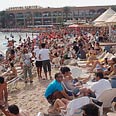
Eilat. Nothing to offer?
צילום: יוסי דוס-סנטוס
Tourism minister plans to upgrade Eilat
Misezhnikov says Israel's southern resort city has little to offer local, foreign vacationers, meaning Israel is losing tourists to Egypt, Jordan. Minister plans to develop southern shore, adding hotels, attractions; also plans to lower accommodation prices by increasing supply of rooms
"There's nothing to do in Eilat," Tourism Minister Stas Misezhnikov said this week, "which means we are losing tourists to Sharm el-Sheik and all the new construction in the Aqaba region."
"Other than the promenade and a few other attractions, Eilat doesn't have much to offer tourists or Israelis," the minister told Yedioth Ahronoth's economic section.
To change this, Misezhnikov is preparing a plan for the development of southern Eilat. The plan includes the construction of new hotels and guest houses, and the development of the entire shore, which is currently bare except for the Princess Hotel.
The minister also plans to submit a plan for the construction of various tourist attractions in the southern city.
Misezhnikov spent the week of Passover traveling throughout Israel's different tourism sites, and said he also planned to work towards lowering accommodation prices in Israel.
He said he would do this by adding more beds: "I was in a zimmer (guest house) during the holiday, that I booked before the government was formed and before I became tourism minister. I paid NIS 850 ($204) per night for a couple, and that certainly isn't cheap.
"Adding zimmers, guest rooms, field schools and low-ranking hotels is a solution that will lead to a rise in supply, and cause the prices to drop – which will allow anyone to vacation in Israel."
Attractions needed
The minister also said he planned to pass a perennial tourism plan. "It should be a five-year or at least a three-year plan. This way, we can deal with the economic crisis, and also prepare plans that will enable us to compete with our neighbors," he said."We are losing tourists to Sharm, and to Aqaba. We are also losing tourists in the Dead Sea and Tiberias. A perennial plan that includes the construction of attractions will help the tourist branch recover and become competitive," he added.
Due to the water shortage in Israel, Misezhnikov said he would also work with other ministries to promote the idea of rural tourism as an alternative livelihood for farmers.
During the holiday, Misezhnikov spoke with Prime Minister Benjamin Netanyahu and the two agreed to cooperate to turn the tourism branch into one of the leading industries in the Israeli economy.
The minister said his office would submit its plans to the Finance Ministry in the near future, and then to the prime minister.
