



Who gets the cat?
While the question of custody of children is usually the main one in divorce cases, custody of animals often gets pushed aside. A precedential ruling that takes into account the special bond between people and their pets may change that
Legislation of the laws relating to: Prevention of Cruelty to Animals (Protection of Animals,1994) and Prevention of Cruelty to Animals (Experiments on Animals,1994) signified an important direction in the creation of a framework for the protection of animals under Israeli law. In recent years the courts have emphasized the need to protect animals and prevent abuse. Despite this, the situation is still far from satisfactory in the eyes of those who love animals.
There is almost no consideration given to the emotional value that is inherent in the ownership of pets and their place in the family. Those who love animals are liable to feel that the Israeli legal system is indifferent to the special status of pets. Hence the importance of the ruling by Judge Shochet, which deals with the main question: How similar is a close relationship with pets to the relationship with children? This question can be answered in several ways. I focus here on one approach: that can one draw a legal parallel between the principle of “the good of the child” and “the good of the animal?”
- For the full article, click here
The situation under discussion refers to a man (John Doe) and woman (Jane Doe) who lived together between 1996 to 2001 (without being married). During this period of time they acquired Jane Eyre, a blind cat, and Shaina, a dog that was sick when she came to the couple and subsequently underwent a hysterectomy. At the end of this period the couple’s relationship ran into difficulties. In 2001 the defendant moved out of the apartment, taking with her her belongings, including the two animals. It is these two animals that were the subject of this dispute. Two years after the separation, in the maelstrom that ensued during the litigation of financial matters, and complaints by the defendant that the plaintiff was harassing her, the plaintiff entered a request for the following: joint custody of the dog and cat in order to divide equally the time spent with the animals or, conversely, the separation of the two animals between the two litigants.

Together forever? (Photos: Visusal/Photos)
The defendant claimed that both animals belonged solely to her, and that she was the only one who had been caring for them for some time. The truth of the matter, she stated, was that the plaintiff had no interest in the two animals and was using them simply as a means by which to harass her.
The court stressed that in order to solve the issue of care and ownership of the pets, it was not possible to use the general principles regarding the acquisition of an item. Rather, it was necessary that the individuality of the pet and the unique relationship between the pet and each person be taken into account. The criterion that the court chose to use was “the good of the animal”, thereby awarding possession of the animal based on the consideration of its needs. The court requested the opinion of an expert to determine what would be for the good of the animals. Such needs as the appropriateness of the physical home, the person’s ability to care for the animal, and the time that that person could give to the animal, were taken into account. In the end the court ruled that the animals would remain in the care of the defendant.
The importance of this ruling lies in its establishing that animals do not come under the definition of “objects”. In other words, the court took the animals out of the category of property.
It is clear that when the expression “the good of the animal“ is used we may tend also to associate this with “the good of the child.” This comparison between the status of a child and the status of animals bears further investigation. What are the commonalities between the good of the animal and the good of the child?
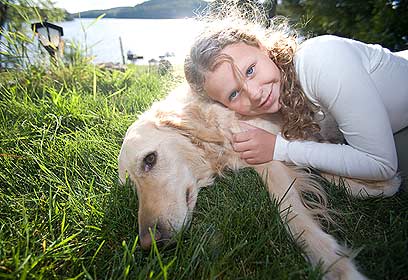
Dogs and kids - equal status?
The good of the child is the ruling principle in anything involving a legal declaration regarding children. The necessity for criteria regarding the good of the animal can be viewed from different perspectives. A claimant might state (especially if the subject of children’s rights is close to their heart) that such a comparison is liable to blur the distinction between how we are obligated to care for children and how we are obligated to care for animals.
The formation of a bond
When asking the question “Whose child is this?” one can generally obtain a clear answer. The issue of parenthood is a biological one, or, in the case of adoption, the result of a court ruling. In contrast to this, the legal bond between animal and man, even if referred to as adoption, is established by the principles of ownership (gift, purchase, or the appropriation of abandoned property).
But the fact that one person had invested the majority of effort and money in the care of the animals is not in and of itself enough to establish ownership. The issue of ownership would not be contingent upon the relationship of the animal to either member of the couple.
Dissolution of the bond between biological parent and child can be done by means of giving the child in adoption to another family if the behavior of the biological parents (or of one parent) makes this necessary or if there are dangers that threaten the child and which require that the social service institutions intervene to remove the child from the family. If a comparison is sought here one could say that when the owners of the animal abuse it, it is the prerogative of the authorities to take the animal away from its owners and give it to someone else.
The developmental outlook
It is the nature of children that their needs, surroundings, understanding, and even the bond that they form with the family, vary over the years until they become adults. The time of childhood is a temporary one; at a certain point the child becomes an adult. In regard to animals, although the process of aging may influence the manner of care needed, in respect to their overall status animals will always remain dependent on their owners. There is yet another way in which the care of children and animals is not parallel. With an animal its age does not necessarily determine which one of the couple will keep it. In contrast, the age of the child has import when deciding upon with which of the parents he or she will stay. According to Jewish law, when we speak of an infant or a minor under the age of six, the child will stay with his mother. This criterion is not relevant in regard to animals; the question does not even arise.
Scope of needs
A different set of circumstances is brought into play regarding the good of the animal. For instance, education is a crucial issue in regard to the care of the child. This is not the case with animals. Socialization, future lifestyle, or considerations of religion are irrelevant concerning the needs of the animal. The gender of the child too may influence which parent will care for it. This is not the case with animals. The good of the child is often a function of the socioeconomic situation of the parents, and the preference of the court as to which lifestyle is preferable for the child. This consideration has no significance in the case of animals. The nutritional needs too are different.

Emotional bond
The good of the animal is assessed according to various principles, such as the emotional bond between the animal and the person, the time and resources that the person can devote to the animal, and the physical space available to the animal.
The preferred choices of the child vs. the preferred choices of the animal
When it comes to the care of a minor, it’s common to take into account the opinion of the child (above a certain age). It is a given that the preferences of the minor will be taken into consideration when determining which parent will care for the child. It is well known that a large part of the decision of the secular and rabbinic courts regarding “the good of the child” is based on the opinions of social workers or psychologists who, among other things, clarify the preference of the minor. In addition there has been a transition from the concept of “the good of the child“ to “the rights of the child.” As a result, it is increasingly common that the child’s defined cultural identity should be recognized. Likewise, it has become acceptable to provide the minor with the opportunity to represent him or herself in court.
It is clear that when speaking about animals there is no reason to speak of “the right of identity” or “the right to citizenship.” Nevertheless, the court can certainly take into account the preferences of the animal, and it is certainly appropriate to do so. Thus, for instance, one should give thought to ways to represent the animals.
Visitation rights
As the dog did not remain in his care John Doe had requested visitation rights. The animal behavior expert agreed to a regimen of authorized visits (as is the case with children), but the court did not agree.
Under certain circumstances the visits are not only for the good of the person who loves the animal, but also for the animal itself. There are certain types of animals (e.g, dogs) that enjoy the social connection with different people, including their former owner. Therefore, one should not rule out the possibility that visits can be of benefit to the welfare of an animal that loves to go outside, to play with people, etc. In this particular instance the court decided that weekly visits with John Doe were irrelevant to the dog. In the case of “the Does”, Judge Shochet decided that visits were likely to perpetuate the friction between the two.
An examination of the good of the animal in light of the interests of others
One of the problems in discussing the status of animals in Israeli law is the following: while Israeli law does protect animals and prohibits their abuse, it does not decisively forbid their exploitation, and in actuality the protection of animals is subject to the needs of people. This approach is undoubtedly the one most taken.
Here we have again to distinguish between children and animals. There are those who reason that, in cases of child custody, one has to award consideration of the good of the child greater weight. In contrast to this, there are those who reason that even when it comes to the good of the child other interests must also be taken into account, such as the overall wellbeing of the family, the needs of the other children, the needs of the parents, etc.
It is easy to see that the good of the animal does not require such criteria, except when a decision must be taken. Individual examples of this include the following: when the family pet is used by one member of the couple to make a living (given, of course, that there is no abuse of the animal). In this case, the need for that person to have an income will lead the court to put the needs of the animal aside. When there is a situation where children are involved, and the children love the animal very much, it is likely that their love for the animal will be set as a priority over the good of the animal. Obviously the animals will remain with the children.
"Animals and Family Law: On the Meaning of “The Good of the Animal” in the Establishment of Ownership of Pets," Pablo Lerner, The Center of Law and Business, Ramat Gan
The full article was published in Animals and Society
To contact Animals and Society: [email protected]
Translation: Rena Meriash-Levine
