


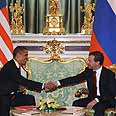
US, Russia agree to pursue nuclear reduction
Obama, Medvedev meet in Moscow, strike preliminary deal to reduce nuclear warhead stockpiles to as few as 1,500 each
US President Barack Obama said he and Russian President Dmitry Medvedev are countering "a sense of
drift" in relations between their nations with preliminary agreement Monday to reduce the world's two largest nuclear stockpiles to as few as 1,500 warheads each.
"We must lead by example, and that's what we are doing here today," Obama said as he and his Russian host pointed their arsenals toward the lowest levels of any US-Russia arms control agreement. "We resolve to reset US-Russian relations so that we can cooperate more effectively in areas of common interest," Obama said.
The document signed by the two leaders at a Moscow summit, Obama's first in Russia, is meant as a guide for negotiators as the nations work toward a replacement pact for the START arms control agreement that expires in December. The joint understanding completed by Obama and Medvedev, signed after about three hours of talks at the Kremlin, also commits the updated treaty to lower longer-range missiles for delivering nuclear bombs to between 500 and 1,100. The limit for warheads would be no
more than 1,675 each.
Under current treaties, each country is allowed a maximum of 2,200 warheads and 1,600 launch vehicles.
A White House statement said the new treaty "will include effective verification measures."
"The new agreement will enhance the security of both the US and Russia, as well as provide predictability and stability in strategic offensive forces," the statement said.
The leaders announced several other deals meant to show progress toward resetting badly damaged US-Russian relations, including permission from Moscow for the United States to transport arms across its land and airspace into Afghanistan for the war there. The White House says the deal will save the US $133 million a year, by waiving transit fees and shortening flying time.
Other side agreements meant to sweeten Obama's two days of talks here include revival of a joint commission to try to account for missing service members of both countries dating back to World War II and fresh cooperation on public health issues. The commission was first created by the first President Bush and President Boris Yeltsin in the early 1990s, but the Russians later downgraded their participation. The US hope is that the Russians will open some of their more sensitive archives to US researchers seeking details about missing American servicemen.
