


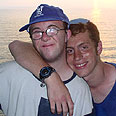
Reaching new heights
At the amazing summer camp run by the Shalva organization, mentally and physically challenged children, and their parents, have the one thing they all need but have almost forgotten: Fun. Ariana Melamed enjoyed an unforgettable day
There are hundreds of people among the eucalyptus trees at Shalva’s summer camp in Achziv, which is in session for the twentieth time. They will have a “Survivor” day and days for music, trips and swimming, challenges and lots and lots of basic, childhood fun, which is such a complicated matter for themselves and for their parents.
Able to breathe
As we approach, the fire truck hoses everyone down with water. The joy is boundless. All the special needs melt away before what is really important: Everyone at the exhibit, with its fire trucks, sirens and hoses, and the mounted police who make their well-trained horses gallop and invite everyone to be fingerprinted and watch how the robot works and what a police dog does, is a kid. In a little while, they promise, there will be a magician. They still need to calm down from last night’s challenging bungee jumps, when the children and adults were lifted out of their wheelchairs and learned, with fear and tremendous courage, how to hover. Incidentally, all this is provided for free.
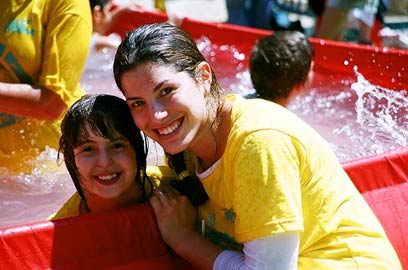
Simply having fun (Photos: Yair Hovav)
The melting smile of Ortal Karp, 13, does not betray any difficulty. As she talks enthusiastically about “A Special Star Is Born” and is even ready to sing a little, my heart refuses to pigeonhole her as a victim of Sotos Syndrome. Developmental delay is only one of the physical and mental problems that her smile will have to cope with, now and in the future.
When we hear the children singing “We love Aharon” as they look at Aharon Yisrael, 19, who suffers from Cockayne Syndrome, in which the body undergoes rapid aging until certain death at a young age, compassion mixes with joy over this special moment that he has been given. Words, which are so much smaller than anything that happens here, simply vanish.
Every summer, parents of special-needs children find themselves coping with summer vacation without the government’s meager support, dependent on the goodwill of volunteers. Not everyone can offer a solution for a 30-year-old woman who will always be a little girl, a boy who will never know how to take care of his insulin pump, who needs a constant companion in order to understand the world around him and keep watch over his oxygen supply at night.
Freedom for parents
Far from the eucalyptus trees, all of these would be labeled as tough cases. But at the Shalva camp, nobody is scared off by the difficulty, and everyone who is more fortunate is mobilized for a single mission: fun – because that is what body and soul need in August whether they are handicapped or not. And clearly, the parents of these children need a break from the days and nights of relentless, demanding, ongoing care that has no end, with its scraps of comfort that are only few and far between.
“This is exactly what I wanted to give to families like ours,” says Malki Samuels, who founded Shalva – an acronym in Hebrew for “Freedom for the Family and the Special-Needs Child” – as a non-profit organization twenty years ago. Shalva helps hundreds of special-needs children every day of the year, and gives them the best of the treatments that they need but cannot afford. Each child spends one night a week at one of the Shalva centers, thereby giving their parents a chance to take a small breather, and be regular people rather than parents whose role involves so much pain and effort.
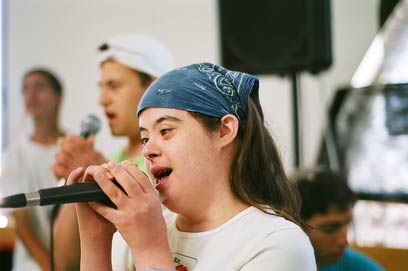
Singing 'I say to you thank you'
Samuels and her family have been very familiar with this reality ever since their son, Yossi, at the age of eleven months, was given a tainted vaccination at a public health clinic, that transformed him from a healthy baby into one who is blind, deaf, hyperactive and limited in his movement. The doctors told them that he would always be imprisoned in the body that had betrayed him and then gave up, never guessing how far Malki and Kalman Samuels would lead their son.
At thirty-three, he is still a child. He was very scared prior to his bungee jump, he admits, using words that are only partly intelligible together with sign language in a lively conversation that his father and brothers translate for me. In this conversation, Yossi will tell me proudly that he lit the Hanukkah lights with President Bush, visited the Swedish Volvo plant because he is a car freak, that he intends to meet President Sarkozy, but particularly Carla Bruni, and that I should take his business card, which is written in Hebrew and Braille and shows sign language symbols on the flip side, and also that I should call his cellular phone, which vibrates every time his many friends call him. Finally, after a conversation that goes from grape varieties and wine to Yossi’s statement that unlike his entire family, he is somewhat lax in matters of religious observance, he lets me give him a hug and tell him that he’s a hero.
Yossi was eight years old when he learned, for the first time, what a word was, and learned to sign with the help of Shoshana Weinstock, his teacher from the Jerusalem School for the Deaf. This was the sign that Malki Samuels had asked for when she vowed to assist other families in the same situation. Treating Yossi demanded an enormous amount of strength and resources. His parents also needed strength for their five other children, and amid all this they wanted to remain human beings, too. Malki, who looks like a bubbling fountain of joie de vivre, made her decision, sweeping her family along into the adventure that, for them, will never end.
The dream: Special center in Israel
Shalva is the result of Malki’s vow. But as Rabbi Kalman Samuels says, “Yossi is always our source of inspiration, because if he got to where he’s gotten to, then every child with special needs can make progress and be built up as well, if only given the chance.” Today, after having been torn between a career in management of information systems and Shalva’s continued growth, Samuels is the organization’s chairman, supervises a daytime rehabilitation center and a nightly respite center, as well as a program in which parents and children receive treatments and therapies for all their special needs under one roof.
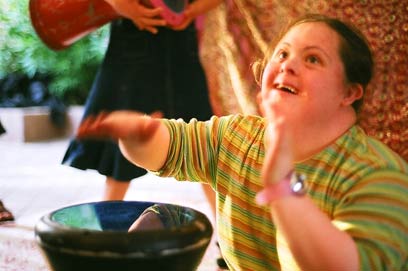
Enjoying a musical moment
Their latest dream is to construct the first treatment center of its kind in Israel, which will be entirely dedicated to the children’s needs. The center will include a special swimming pool, gym, occupational therapy rooms, a fully accessible auditorium where they will be able to sing and dance, and a playground designed for them. Another $6 million are needed in order to establish this center, the total cost of which is $40 million. Although several economic leaders in the United States have fallen on hard times, these worries do not keep Samuels from giving one child a hug while rushing a medic to another whose toe is bleeding and telling a third, with a smile and a hug, that he is the most terrific kid in the world. We should also mention Tali Hayut, one of hundreds of volunteers at the camp, who received a citation this year from the welfare minister for her work, but that is not what motivates her. All she wants is for her camper to smile.
The children come from all over the country. The volunteers come from all over the world. “We have groups and individuals, teenagers and older people who come to be with us at the camp every year,” Samuels says with satisfaction. “Without them, we wouldn’t be able to keep the camp going, since every child here needs his or her own counselor and every counselor knows that only the children get their own rooms, and most of the counselors will have to sleep in the tent.” He laughs as he recalls that every year, they fight over the privilege of sleeping in the tent.
The Samuels’ enthusiasm and Shalva’s amazing organizational ability have charmed not only the Israel Police, the Fire Department and the Israel Defense Forces, but also players of the Hapoel Jerusalem basketball team and students at the Bezalel Art School, who come to work and draw with the children. There is a long list of places that Samuels would like to take this opportunity to thank, but he does not manage it. Here comes a child, confused and speechless and upset, who needs a calm, responsible adult to stroke his head and ask him what is bothering him. It is impossible, in this large, noisy, happy group – even with all the worries – to sit down and have a normal interview. Maybe it’s not even necessary. The children and their desires and needs get first priority.
One group comes back drenched from the pool, another is heading off to aerobics, and when everyone is wearing a camp T-shirt, it is hard to distinguish between the counselors and the campers. That is no coincidence. “One of our dreams was to create maximal integration between typical healthy teenagers, who come here every year for fun days at the camp, and our children,” Samuels explains. “This year, we were particularly successful. They play ‘Survivor’ together, they have days of music and creative arts together, and this togetherness leads only to good things. It’s not just tolerance and the ability to include the other, but also simple human friendship, the joy of giving and the joy of mutual receiving, for everyone.
"If the observer can’t tell the difference between a camper and a counselor anymore, we’ve succeeded. We’ve succeeded in bringing these special children back to their place among all of us and making each group happy by being completely blind to labels and seeing only everyone’s wants and needs.”
Ortal comes to say goodbye, and I just want her to keep on hugging me. She urges me to come to hear her sing. Yossi puts a disc in my hand that contains a film in which he played the starring role, “About Yossi,” which was broadcast recently on Channel 2. Another camper, a deaf grown man who lives in a halfway house and comes for a vacation every year, points to a sore on my elbow and asks if it hurts.
What hurts, I want to tell him, is the fact that outside, beyond the eucalyptus grove, there are so many more children and adults who need an experience like this camp, but there are not enough resources for everyone. What helps, after a day with the children of Shalva, is the knowledge that at least some of the children are receiving it, and that there are teenagers and adults who have learned that this work, with all its difficulty, is entirely a privilege.
