


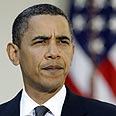
Obama. Nobel for noble intentions
צילום: AP
America’s ineffective stick
US showed willingness to use military force, but fell short on vision
“Speak softly and carry a big stick, you will go far.” US President Theodore Roosevelt saw this approach as the key to the American empire’s success. Yet this is based on two assumptions: First, if others fail to listen to you, you will indeed make use of the big stick; secondly, if you get the attention you sought through the stick, you will know not only what you want, but also how to turn your intentions into reality.
When examining American policy in recent years, one starts to wonder. The Americans enjoy the world’s attention; on occasion they make use of the stick, but all too often it isn’t clear whether they know what to do with the attention that their stick grants them.
The American wars in Iraq and Afghanistan were meant to make it clear to the whole world that the US will not hesitate to use its military when necessary. These wars granted Uncle Sam the world’s attention. Whether they appreciated George W. Bush or whether they despised him, everyone realized – the oppressors and oppressed, allies and rivals – that the global sheriff is willing to go far. But go where? For the time being, it’s not quite clear.
The US failed to make it clear that it has the required vision and abilities. Democracy? Stability? Peace? Sure, but how? That’s unclear. Time and again the Americans get in trouble. Time and again they lose their patience. What, you don’t want peace, democracy, and McDonald’s? No need then.
When one does not know how to use it, the stick becomes ineffective, as big as it may be. There are many forces in the world that have limited power but unlimited patience. The slow erosion can be a highly effective means against the greatest powers.
American policy in the Middle East in recent years is an example of the absence of vision, which boosts dangerous processes. The American involvement in Iraq did not bring stability to the region, but rather, instability, among other things because the Americans had no realistic vision in respect to the outcome of Saddam Hussein’s defeat. We toppled him, and now what? Democracy and peace.
Unable to take responsibility
Iraq and Iran have been engaged in a tense balance of power for thousands of years. The US removed Iraq from the equation without creating a proper substitute. This is the reason for the revival of Iran’s hegemonic dreams. If you add to this the drastic rice in oil prices, in which America played a significant and outrageous role, you end up with a problem.
On the other hand, the Islamic republic provokes great resistance in the region – resistance that could have been enlisted to the cause of a diplomatic move that would prompt the unification of anti-Iran forces. The key step here is removing the Israeli-Palestinian conflict from the equation.
The Israeli-Palestinian conflict has not been an Israeli-Palestinian problem for a while now. It is a means used by radical forces in order to create resistance to the US, which is presented as an oppressor of Muslims via its regional ally.
What makes the above-mentioned move easier is the fact that Israel is completely ready for it, and it serves its interests as well. The processes that took place in Israel since Oslo show that Israeli society is willing to accept an agreement that includes withdrawals and evacuations, so that it can focus on its domestic problems.
Meanwhile, Palestinian society has also grown tired of the struggle. All that is missing now is political leadership capable of taking responsibility for the move.
This is precisely the point where the US could have acted. The problem is that Uncle Sam is again being revealed to be devoid of vision and unable to take responsibility. Obama’s statements, which everyone hoped manifested the rise of an administration that knows what it wants, dissipated at great speed – this raises concerns that it was not George W. Bush, but rather, some deeper flaw that curbs American policy.
It’s nice to be awarded the Nobel Peace Prize for noble intentions. However, the Americans are not short on good intentions, but rather, on willingness to take responsibility.
