


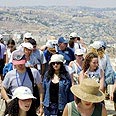
All-time record in incoming tourism
330,000 tourists visited Israel last month; 2.3 million since beginning of year. Minister of toursim: 'Increase due to focused marketing, positioning of Israel as Holy Land, with Jerusalem as its capital'
The numbers reflect an increase of 9% from October 2008.
From the beginning of the year 2.3 million tourists visited Israel – same as the total number of tourists during 2007, and just a 12% decrease from the same period last year.
According to the Central Bureau of Statistics (CBS), October saw an increase of 6% in the number of tourists who visited Israel and stayed for a minimum of one night, compared with October of 2008.
An increase was also recorded in the number of day visits (20%) as well as cruises, which reached a total of 23,500, doubling last year's numbers.
"These numbers are as a result of focused marketing, analysis of the target market and investment in proper infrastructure for continuous global marketing, based on the positioning of Israel as the holy land, and Jerusalem as its capital," said Tourism Minister Stas Misezhnikov (Yisrael Beiteinu), who is currently visiting South America.
In an interview with Yedioth Ahronot, Misezhnikov said, "our product is flawed", referring to the tourism industry in Israel.
"Unfortunately, we do not know how to market tourism," said the minister ahead of a tourism convention in Herzliya, adding that there are many reforms he plans on implementing during his term in office, among them bringing a million additional tourists to Israel in the next three years.
Decrease in Israelis traveling abroad
Meanwhile, figures also indicate that between January and October of 2009, a decrease of 6% was reported in the number of Israelis traveling abroad, compared with 2008.
Those who did travel outside the country, did so mainly by air (85%), with some 3 million exits (5% decrease from last year), while 416 thousand exits were recorded by land (11% decrease) and 115 thousand departures by sea (increase of 5%).
During January and may of 2009, a decrease of 12% in the number of exits was recorded, compared with last year's figures. The sharp decrease was probably due to the global financial crisis, as well as Operation Cast Lead, which took place in the first half of January.
