


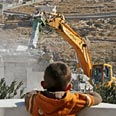
Israel razes Palestinian structures in West Bank
Israeli forces knock down 15 structures that were home to some 150 Palestinians in Khirbet Tana near Nablus, claiming they were built on military training ground
Israeli forces on Sunday knocked down shelters that were home to about 150 Palestinians in the West Bank council of Khirbet Tana, Palestinian officials said.
A spokesman for the Israeli authorities in the West Bank said 15 "illegally constructed structures were removed". They had been built on a military training ground, "endangering the lives of those present", Lee Hiromoto, the spokesman, said.
Ahmad Mazen, Khirbet Tana council secretary told Ynet that the main people to suffer from the demolition are the farmers who lost their stables. He said two classrooms in which the farmers' children studied were also razed.
Mazen said that in 2005 the High Court of Justice ruled that the construction of the structures was not legal, and the residents' efforts to overturn the ruling were in vein.
"Today there are 15 farmers that have nowhere to keep their herds, and there are students in the area that have no place to learn."
Atef Hanini, a local Palestinian official, disputed the Israeli justification and said the Palestinian farming community had lived in the area of Tana, east of Nablus, for decades.
A mechanical digger ploughed through what remained of one of the shelters and a Palestinian woman remonstrated with Israeli soldiers at the scene. The structures included homes, stables and a school.
Hanini said the residents had defied Israeli instructions to demolish the structures themselves. Hiromoto said numerous warnings and evacuation orders had been issued.
The Rabbis for Human Rights organizations said the sheds were build some four years ago with the help of the organization, and that the location in which they were placed did not pose a security threat and was not meant for military training.
According to the organization, the structures were raised in order to expand settlements in the area.
Ali Waked and Efrat Weiss contributed to this report
