


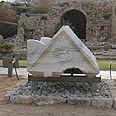
Medusas in Caesarea harbor
New archaeological exhibition displays for first time beautiful 1,700-year-old sarcophagus lid decorated with mythological medusa heads, along with other ancient artifacts
The cover, which weighs more than four tons, is decorated with snake-haired medusa heads and joyful and sad-faced masks. These were taken from the world of the ancient theater where two kinds of plays were customarily presented: comedy and tragedy.
The meaning of the Greek word "medusa" is “guard or sentry”; whoever looked directly at the mythological medusa would be turned to stone immediately. In antiquity they used to produce medusa reliefs on, among other things, tombs and various shields, in the hope that this would ward off the threat.
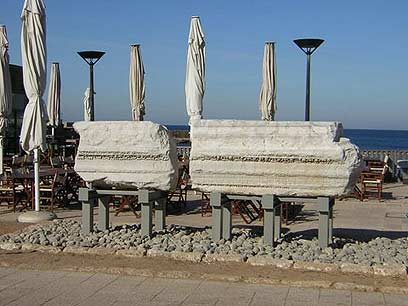
Items in exhibition (Photo: Gabi Salomon, courtesy of Israel Antiquities Authority)
Interment in large stone coffins (sarcophagi) was widespread in the Mediterranean basin in the second to fifth centuries CE. This funerary custom was first practiced among pagans and was later also adopted by Jews, Christians and Samaritans. The word sarcophagus is Greek in origin, meaning “flesh-eating”.
The sarcophagus has two parts: A rectangular chest-like receptacle in which the deceased was placed and a lid. The sarcophagi were interred inside burial structures (mausoleum; pl. mausolea) or in rock-hewn burial caves. The residents of ancient Caesarea were buried in cemeteries that were located in regions outside the built-up area of the city.
The impressive sarcophagus cover, which was probably used in the burial of one of Caesarea’s wealthiest denizens in the Roman period, is one of an assortment of unique stone items that were exposed in archaeological excavations and by other means in Caesarea. The items constitute living and tangible evidence of the lives of the rich in Caesarea, at a time when the city was a vibrant Roman provincial capital.
Rich source of information on history
The Israel Antiquities Authority organized this exhibition together with the Caesarea Development Corporation and Israel Nature and Parks Authority, and views it as the first of many other archaeological exhibitions that will be held in the Caesarea harbor compound, based on the many artifacts that the IAA uncovered there over the years. The exhibition curator is Ayelet Grover of the Israel Antiquities Authority, and the exhibit designer is Architect Boaz Kedar.
Another unique find presented in the new exhibition is an item that was part of a large magnificent building and which bears a dedicatory inscription by a woman who was apparently named Cleopatra. It seems that she and her son or daughter were members of a family of local nobility that donated the structure to Colonia Caesarea.
Also on display here is a sarcophagus that bears an inscription written by Eliphis, a husband, who dedicated the sarcophagus to his beloved wife Manophila. The inscription also states that “man is not immortal and such is life…”
The inscriptions are a rich source of information for understanding the history of Caesarea in the Roman and Byzantine periods. We can learn from them about public life in the city; its institutions, political ties and personal relations, and about the city’s residents – their names, professions and religious beliefs.
