


Israeli education: Losing faith in system
Nearly half of Israel's junior high students use private tutors, as faith in education system slips
The data again places Israel at the bottom of the list among Western nations. Some 42% of seventh and eighth grade students and 38% of fifth and sixth grade students require the help of private tutors for at least one of the core subjects (math, Hebrew, science or technology.) The figures are commensurate with a report released about a year ago by Professor Dan Ben David, which showed that 38% of Israel's junior high students need to supplement their math studies with at least four hours of extracurricular work. The average in OECD countries is much lower and stands at 15%.
The phenomenon has greatly expanded in recent years, with students turning to private tutors in subjects such as history, literature, and Bible as well. The utilization of tutors has even gained a foothold among young children, with many parents arranging private lessons for their preschoolers.
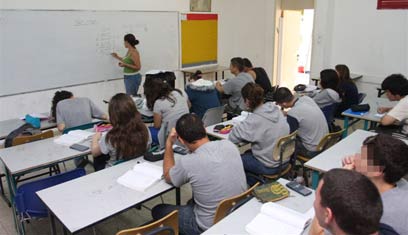
Crowded Israeli classroom (Photo: George Ginsburg)
"I usually arrange my week so that on Sunday I have an English lesson, on Wednesday a math lesson, and on Thursday a Hebrew lesson – but next week I have a math test, so I decided to focus on one subject only and took math lessons almost every day." This is the normal routine adopted by Shir, an 11th grade student from an upscale community in the Jerusalem area.
When he studied in elementary school, Shir was embarrassed to admit that he uses private tutors. In recently years, not only has the shame disappeared, but students boast of being able to arrange lessons with the most prominent teachers. "We talk to each other during breaks and recommend which teachers should be hired and who can teach in a fun way," he says. "During class we barely listen, both because it's hard to concentrate for so many hours and also because we know that we have no reason to make an effort – in any case, we'll review the material in a peaceful atmosphere with our private tutor."
'This is the norm'
Officials at Shir's school encourage weaker students to enroll in extracurricular classes and even recommend prominent teachers. A similar situation prevails in the high school where Liat, a recent graduate, studied. "It was clear that in class you can't really study, and those who want good grades need to pay money and sit one-on-one with a private tutor," she says.Under the current circumstances, Israeli parents understand there is no other choice. "I don't trust the education system and I'm unwilling to have my girls fall behind," says Yael, a mother of two daughters in grades 12 and six from Tel Aviv. "My young daughter studies algebra, and in classes of 40 students it's impossible to understand the material. I'm not waiting for her to fail; I went ahead and paid for a private tutor."
Miguel Herf, the chairman of the parents' association in the town of Modiin, pays NIS 150 (roughly $40) per hour for private lessons in Hebrew for his son. "To my regret, today this is the norm, whereby parents who can afford it pay for private lessons. This is a wrong, twisted method, yet the level of education at schools is incommensurate with the needs. No parents agree to have their child stay behind, as matriculation grades are the entry ticket to university…the wealthier the parents, the higher their children's chances to excel in their studies."
"Free education is the greatest joke there is," says Dudi Feliser, formerly the parents' association chairman in the city of Rehovot. "We, the parents, buy with our money our children's achievements via private lessons. Every year, schools boast of rising grades in matriculation grades, yet it's a bold lie. They are in fact taking pride in the money we paid. If they checked the level of knowledge only based on studies at school the results would be grim."
'Rich parents, high grades'
The growing trend is being encouraged by school teachers too, "who understand that in a classroom of 40 students they have no chance to reach everyone, and there will always be those who fall behind," as one northern Israel teacher says. Many teachers recommend colleagues from other schools as private tutors. "Private lessons have turned into a built-in feature in the system in recent years, and it's taken for granted that a student who enrolls in intense math or physics studies will pay for a private tutor."The rising demand for private lessons mostly attests to the lack of parental faith in the public education system, where "teachers function less as an education official and more as a social worker, psychologist, and police officer because of the discipline problems," says Dr. Marita Barabash, deputy president of the Ahava education college. According to a Ynet inspection, the per-hour tutoring fee for the most desirable subjects (English, math, physics and chemistry) ranges between NIS 100 (roughly $30) for a professional tutor during the school year and NIS 200 (roughly $60) during the matriculation exam period. With such rates, it is no wonder that children from lower socioeconomic strata fall far behind.
Beersheba resident Mazal recounts her own experience: "My daughter completed her studies a year ago and I had no possibility to help her. I work part time and my husband makes a living through an income supplement. Private lessons for my girl were out of the question. Thankfully, city hall helped us and provided my daughter with extra help that enabled her to complete her studies with a full high school diploma.
Shalom Barbi, the deputy chairman of the parents' association in Dimona, cannot afford private lessons for his daughters. "Here in Dimona, only the children of the wealthy have money for private tutors. The other residents are simply forced to tell their children they can't have lessons. Many of us don't speak English, so for lack of other choice I turned to our neighbors from the Black Hebrew community and asked them to help my children with English lessons. It's very important for me to have my daughters succeed in their studies, but I need to provide for my family, and with my salary there is no way I can afford a private tutor. Those who have rich parents have high grades."
- Follow Ynetnews on Facebook
