


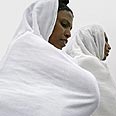
Ethiopians coming home
Monthly immigration quota to be doubled from 300 to 600, government decides
JERUSALEM - The last 20,000 Ethiopians who claim they were forced to convert from Judaism will be brought to Israel by the end of 2007, according to a government decision announced Monday.
Ethiopian immigrants demonstrated in front of Prime Minister Ariel Sharon's office as he discussed the issue, demanding their relatives be allowed to join them in Israel.

According to the decision, the monthly immigration quota will be doubled from 300 to 600 starting in June.
Immigration of these Ethiopians, called Falash Mura, has evoked heated arguments in Israel for years.
While Ethiopian Jews have strong ties to Judaism dating back more than 2,000 years, the Falash Mura say they were forced to convert to Christianity in the 19th century and are now embracing their original religion.
But skeptics, including some in the Ethiopian immigrant community, charge that at least some of the 20,000 waiting to come to Israel are impostors - latching on to the Falash Mura label in order to escape their poverty-stricken country.
Jewish Agency Chairman Salai Meridor called the charges "ugly" and said the potential immigrants all qualify under criteria set up by Israel's government.
The Jewish Agency estimated the actual number of Falash Mura still in Ethiopia at 14,000-17,000. About 20,000 already live in Israel.
Since 1991, members of the Falash Mura have been leaving their communities and moving into holding camps in the capital, Addis Ababa. Conditions in the camp are difficult, and Ethiopian immigrants in Israel complain that their relatives have been suffering.
The Falash Mura claim descent from Ethiopian Jews forced to convert to Christianity in the 19th century because of persecution. Israel does not recognize them as Jewish, and they do not qualify for citizenship until they convert to Judaism under an Orthodox Jewish process that takes up to two years.
The government imposes an eligibility test for Falash Mura, requiring Jewish descent on the mother's side.
