


The Ambassador conquers Jerusalem
Previously on the Ambassador: After an introduction to Tel Aviv, a tour of a kibbutz and a trip through northern Israel, NB Simon is desperate for ideas. He travels with cousin Martin and the friend, Amnon, to Jerusalem. Together they do Independence Park, Nahalat Shiva, and the Western Wall. On the way back to the true holy city they stop for hummus
I'll admit it: the last time I was in Jerusalem most of its inhabitants were Jebusites, and the Western Wall had a big sign on it saying: "This project will be completed by April 512 BC." Most of my Tel Avivian friends concurred. Most of us avoid visiting our eternal (and by "eternal" I mean till Ahmadinejad will press the red button) capital.
The reason is, of course, the false reality of the complacent Tel Avivians: They are certain the world is comprised of people like them. If you spend your life in central Tel Aviv, you might think the world is filled with people by saying "coffee," they actually mean "cappuccino," work in advertising, never miss a spinning class, and favor movies by Antonioni.
Neighborhoods named after torture apparatuses
Jerusalem with its ethnic groups, religions, nationalities, characters, and Betar fans, places a mirror in front of that Tel Avivian: "You're in the minority, pal, and if the s… hits the fan, you better run." Same happens every elections when an average Tel Avivian votes for Meretz like all of his friends, and is shocked by the fact the left-wing party ends up with four seats.
Did the Jebusites leave yet?
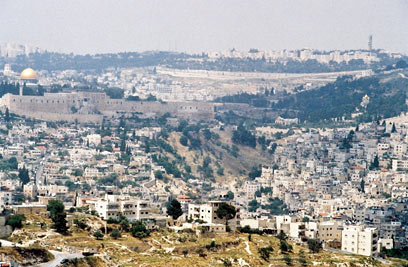
Add Jerusalem's chaotic topography to the mix and the neighborhoods with names that sound like torture apparatuses (the Russian Compound, Valley of the Ghosts) and you'll understand the frightened Tel Avivan. (By the way, I'd like to thank Jerusalem's municipality for placing dozens of signs throughout the city pointing westwards in Tel Aviv's general direction, like "eject" buttons that will send you back to normalcy.)
As is evident from all of the above, I am probably not the ideal guide to accompany Martin through the Holy City's alleys. So, I called on my Jerusalemite friend, Amnon, for help.
The Jewish community of Jerusalem is roughly divided in two: Betar fans versus Hapoel fans. This is not the place to talk about the former. True, I too know one Betar fan who reads Kafka, listens to Chopin, and studies sociology. I also know that every week he is attacked at the Teddy soccer stadium. Hapoel fans (basketball) are different: Most of all they resemble kibbutznikim. The only difference is the yarmulke in the glove compartment. Amnon is a Hapoel fan.
More dangerous than an ammunition bunker in Chechnya
So, the three of us, Martin, Amnon and I, found ourselves early in the morning driving towards Jerusalem which welcomed us, as always, with scorched armored vehicles and huge cemeteries. Martin, who dreamt about Jerusalem for years and envisioned a glorious gold and marble city, was disappointed. "Not very feng shui," he said. "Why couldn't you plant some flowers and hang a welcome sign?"
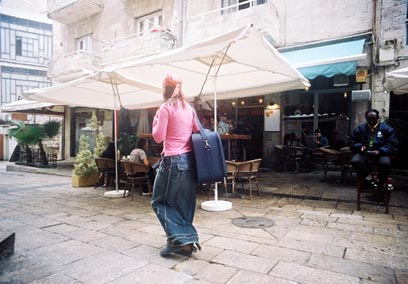
When not stoned, Amnon is an avid Zionist: "My young friend," he turned to Martin, "if you are into kitschy streets, wide boulevards, and lovers strolling through blossoming parks, you should go to London, or Ra'anana. In this place every stone could tell a heroic story of blood and sacrifice, every grain of sand witnessed Jews, Crusaders, Turks and Arabs." Martin was not impressed. "Say, is there a Starbucks? I could use a cappuccino."
Every stone could tell a heroic story of blood and sacrifice
We parked in the center of town and started walking. Independence Park which at night turns into a whirlpool of junkies, needles, and broken bottles, but now provided an innocent, green, background. In Nahalat Shiva's pedestrian mall, Amnon pointed out small, hidden bars smelling of hookahs and beer.
The famous Zion Square seemed peaceful, even pastoral, in its own way. Personally, I missed the riled-up crowds, photos of Rabin in Nazi uniform and coffins, but I guess it's a matter of personal taste.
We continued up the street to the busy Jaffa-King George junction. "Five years ago," Amnon said, "this was the most dangerous spot on earth: More than an ammunition bunker in Chechnya or a Marines truck in Mogadishu." Amnon went on to tell detailed stories of the terror attacks that took place on that junction and pointed out other blood-drenched attractions.
Solving one of history's greatest mysteries
From Jaffa Street we continued to the Old City. Amnon led us through the alleys telling fables and legends about the city's past. Martin was touched, "this is how I pictured Jerusalem," he said. He wandered between the stalls dreamingly, touched the shawls and the merchants, bargained over dried fruit and coffee prices, and bought antique Armenian mugs that were probably manufactured a week ago in some sweatshop in Nablus.
As we reached the Church of the Holy Sepulchre, Martin was gone. We feared he strayed into the Muslim Quarter and I was getting ready to launch a rescue mission that will quickly deteriorate into a third world war, like the one Peretz and Olmert started after a five-minute discussion while they were solving a crossword puzzle.
But, then, he suddenly appeared, wearing a galabiya (traditional Arab garb) holding a small camel made of an olive-tree branch. Finally, a solution to one of the greatest mysteries in Israel's history: Who, for crying out loud, buys these ugly camels? I tried telling him he looked like an idiot but he refused to take off the galabiya. Amnon chose a drastic measure and told him that the guards by the entrance to the Western Wall, wear rubber gloves which they do not hesitate to use on anyone who looks suspicious. "A blond Canadian in a galabiya is a definite candidate for a comprehensive full-body search for explosives."
That worked like magic and the galabiya was folded and shoved into the bag.
Symptoms of Jerusalem syndrome
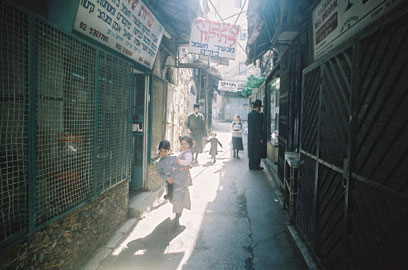
After a visit to the Western Wall that included a cardboard yarmulke, tefillin, a note, and plenty of tears, we drove to another Jerusalemite attraction: A place I never visited because I did not believe it actually existed - the strictly Orthodox neighborhood of Mea Shearim.
The streets were covered with signs that read things like: "Remember and never forget what the evil Zionists have done to you over 59 years of dictatorship!," and "the fastest, safest, best way to make dishes kosher!" The neighborhood seemed like a living replica of an Eastern European Jewish village in the late 19th century.
Mea Shearim: A place I did not believe existed
As we left Mea Shearim I began experiencing symptoms of Jerusalem syndrome: A strong urge to invite people over for Shabbat, a craving for a plate of Jerusalemite mixed grill, and a wish to change my clothes into a robe and a rope.
Amnon recognized my deteriorating condition and knew what the only cure was: A big breath of polluted Tel Avivian air. Therefore, we hastily headed back to safety, not before we stopped at the Arab village of Abu Gosh for hummus. I will not bother you with detailed explanations of which is the best hummus in the village. It's suffice to say that you drive into the village, follow the main road, and drive straight until you see the redheaded Arab guy. Stop there. You are welcome to taste for yourself.
Next week: NB takes Martin to his favorite place in Israel. But you must bring your passport to get there.
Previously on the Ambassador:
