


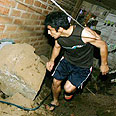
Powerful earthquake in Peru kills 450
(Video) 7.9-magnitude earthquake shakes Peru's coast near the capital, toppling buildings, setting off landslides. ‘Thank you God Almighty, these terrible quakes did not cause a high death toll like in other years,’ President Garcia says
VIDEO - A powerful 8-magnitude earthquake shook Peru's coast near the capital on Wednesday, toppling buildings, setting off landslides and killing at least 450 people and injuring over 1,500 others. Authorities said the quake generated a tsunami but it wasn't destructive.
Peru's highly respected Cable news station Canal N reported that the quake had caused a church to collapse in the city of Ica south of Lima, killing 17 people and injuring 70.
The US Geological Survey said the earthquake hit at 6:40 pm (7:40 pm EDT) about 90 miles southeast of Lima at a depth of about 25 miles. Four strong aftershocks ranging from magnitudes of 5.4 to 5.9 were felt afterward.
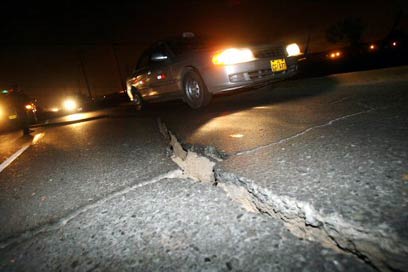
Photo: AFP
Several hours later, President Alan Garcia said in a nationwide broadcast that it apparently had not caused a catastrophe.
"Thank you God Almighty, these terrible quakes did not cause a high death toll like in other years," he said.

The Hawaii-based Pacific Tsunami Warning Center issued a tsunami warning for the coasts of Peru, Chile, Ecuador, Colombia, Costa Rica and Panama. A tsunami watch was issued for the rest of Central America and Mexico and an advisory for Hawaii.
The center canceled all the alerts after about two hours, but it said the quake had caused an estimated 10-inch tsunami near the epicenter.
"It wasn't big enough to be destructive," said Stuart Weinstein, the center's assistant director.
An Associated Press photographer said that some homes had collapsed in the center of Lima and that many people had fled into the streets for safety. The capital shook for more than a minute.
"This is the strongest earthquake I've ever felt," said Maria Pilar Mena, 47, a sandwich vendor in Lima. "When the quake struck, I thought it would never end."
Workers evacuated from Lima office buildings
Garcia ordered all police personnel to the streets of Lima to keep order and said he was sending the country's health minister and two other Cabinet members to Ica, 165 miles southeast of Lima, where news reports said the quake hit hardest. Garcia also said public schools will be closed Thursday because the buildings may be unsafe.
Police reported that large boulders shook loose from hills and were blocking the country's Central Highway east of Lima.
Firefighters quoted in radio reports said that many street lights and windows shattered in Lima but did not specify if there were any injuries. Hundreds of workers were evacuated from Lima office buildings after the quake struck and remained outside, fearing aftershocks
Callers to Radioprogramas, Peru's main news radio station, said parts of several cities in southern Peru had been hit with blackouts. Callers reported homes in poor neighborhoods in Chincha near Ica had collapsed.
The quake also knocked out telephone service and mobile phone service in the capital. Firefighters were called to put out a fire in a shopping center. State doctors called off a national strike that began on Wednesday to handle the emergency.
The last time a quake of magnitude 7.0 or larger struck Peru was in September 2005 when a 7.5 magnitude earthquake rocked Peru's northern jungle, killing four people. In 2001, a 7.9-magnitude quake struck near the southern Andean city of Arequipa, killing 71 people.
The latest Peru quake occurred in a subduction zone where one section of the Earth's crust dives under another, said USGS geophysicist Dale Grant at the National Earthquake Information Center in Golden, Colo.
Some of the world's biggest quakes strike in subduction zones including the catastrophic Indian Ocean temblor in 2004 that generated deadly tsunami waves.
The tsunami warnings caused alarm up and down the coast.
Alex Kouri president of the Callao region, which includes the port of Callao, adjacent to Lima, urged residents to remain calm in the face of any possible tsunami, while other officials told Radioprograms they were going to evacuate La Punta, a Callao neighborhood, because of the potential threat of a tsunami.
In Colombia, President Alvaro Uribe ordered the partial evacuation of the southern city of Tumaco in response to the warning.
