


Olmert: Livni not obligated by my stance
Talking to reporters before leaving for Moscow, prime minister clarifies that his views expressed in Yedioth Ahronoth interview, that Israel should quit most occupied land, are his private views and do not compel new Kadima chairwoman
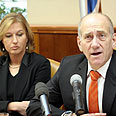
Prime Minister Ehud Olmert clarified Monday that the views he expressed in a Rosh Hashana interview with Yedioth Ahronoth, that Israel should quit most occupied land, are his private views and do not compel his future replacement, Foreign Minister and new Kadima Chairwoman Tzipi Livni.
Talking to reporters before leaving on an official visit to Moscow, the prime minister said, "The views I expressed in the interview about a territory exchange are my views. I am the only person committed to them. This is my opinion.
"This does not compel Ms. Livni. I stand behind what I said and I am the only person responsible for these statements, but none of them compel Ms. Livni," he added.
Despite his resignation announcement last month, Olmert said he was optimistic in regards to a peace agreement with the Palestinian Authority.
"An agreement with the Palestinians could be reached by the end of the year," he said, "but this largely depends on the Palestinians' willingness."
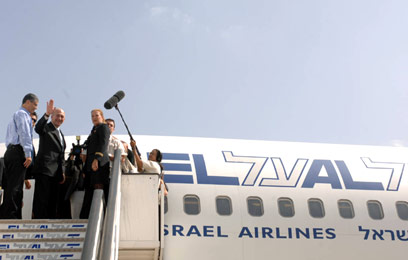
Olmert heads to Moscow (Photo: Amos Ben Gershom, GPO)
As for his visit to Moscow, the prime minister said he would discuss security-related issues with the Russians.
"They have a vested interest in the diplomatic negotiations with the Palestinians and the Syrians, and we have an interest in the security-related issues on the agenda," he noted.
As for the possibility of scheduling a peace summit in Moscow as a sequel to the Annapolis conference, Olmert said "it's too early to determine whether such a conference may take place."
In the Yedioth Ahronoth interview, Olmert saidm "We are facing a need to make a decision, but we are unwilling to say to ourselves that this is something we must do. We must reach an agreement with the Palestinians, meaning we will withdraw from nearly all territories, if not from all of them.
"We'll leave a percentage of these territories under our control, but we'll have to give the Palestinians a similar percentage, otherwise there won't be peace. This includes Jerusalem."
He went on to elaborate on the change in his views. "(Former Prime Minister) Arik Sharon spoke about a painful cost but refused to elaborate. I'm saying there's no choice but to elaborate. We will eventually be forced to withdraw from most territories, and will have to compensate for the territories we hold on to in the form of territories within the State of Israel at a 1:1 ratio, more or less.
"The things I'm telling you now have not been stated by any Israeli leader in the past. It's time to say these things. It's time to put the on the table," Olmert said.
