


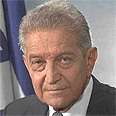
The ultimate Sabra. Weizman
צילום: לע"מ
My Ezer
Late President Ezer Weizman was the ultimate Sabra, Eitan Haber writes
I would like to remember Former President Ezer Weizman just as I saw for the first time after he had shot down two Egyptian warplanes: In the club of the 101st Air Force squadron, leaning on a bar, surrounded by his admiring pilots.
“We screwed them,” he yelled. “Boy, did we screw them.”
Ezer Weizman? It is reasonable to argue over his traits and character flaws, but he will always hold the title of the most colorful person in Israel’s political and military circle.
Ezer was the ultimate Sabra, a product of the renewed Zionist movement in Israel; he was Israel’s life story, the story of its political and military battles.
In short, he was a man of contradictions, and this was perhaps the essence of his charm. He loved people, but most of all he loved himself. His formal education would not have gotten him past basic training, but the range of his knowledge was as wide as the ocean.
His “fuse” was the shortest of anyone I had ever known, but he enjoyed listening and drawing knowledge from others.
Perhaps he could have been IDF chief-of-staff, but he missed the opportunity. People spoke of him as a possible candidate for prime minister, but he was ousted from the Likud party instead.
He was a man of principle who had given up a promotion because he disapproved of the person who was set to replace him as Air Force commander, but ignored ethical codes when it came to his personal financial gain; he was a good friend to his allies, and a dangerous foe to his enemies.
Weizman got Menachem Begin elected in 1977, but it was not the first time he had taken others to the top.
In 1967, he witnessed the Air Force’s unprecedented victory over the Egyptian, Syrian, and Jordanian air forces. In effect, the victory sealed the fate of the Six-Day War within the first three hours of fighting.
Personal tragedy
Despite the fact that Weizman had prepared the Air Force for the war, most of the limelight was focused on Defense Minister Moshe Dayan and Chief-of -staff Yitzhak Rabin.
“A person should not be envious of his son and student,” he said at the time, but those close to him knew how jealous he really was.
Weizman was a staunch supporter of the “Greater Israel” concept, but was also the first to understand it was not feasible, 25 years before Prime Minister Ariel Sharon reached the same conclusion.
He was also the leading advocate for the peace treaty with Egypt.
Weizman experienced the horrors of war first-hand: His son Shaul was badly wounded while serving near the Suez Canal in 1969, and Weizman accompanied him throughout the excruciating treatments right up until Shaul was killed in a car crash in 1991.
Although he had never said it, Weizman was a bereaved parent well before his son died.
Ezer Weizman passed away at a time the country he loved so much has hit one of its low points; perhaps the lord wanted to spare him these difficult times.
Poet Ayin Hillel once wrote:
You were simply a man,
You loved! And perhaps you did not see the cloud of love that walked before you: We saw it.
It is a shame we had not told you this before. But perhaps we could not.
We are simple people and do not compliment often.
Eitan Haber was late Prime Minister Yitzhak Rabin's bureau chief
